
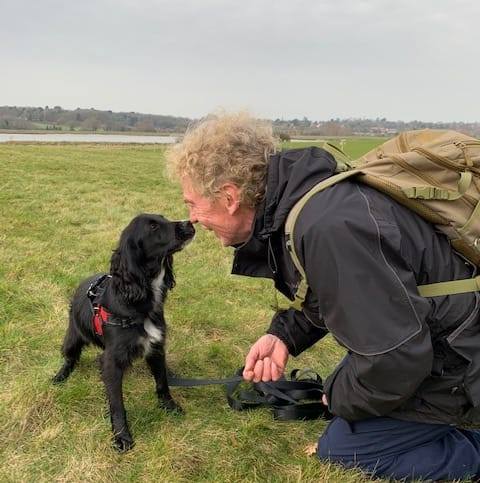
For many years, I quietly assumed I was the anomaly in the dog world.
While much of modern dog training revolved around protocols, reinforcement schedules, markers, food rewards and the four quadrants of operant conditioning, I didn’t consciously “train” in that way at all. Yet I was consistently helping people resolve complex behavioural issues — including human-directed reactivity — without structured drills, punishment, or treat-based compliance work.
That puzzled me.
I had never punished dogs. I had never relied on food as a behavioural currency. What I did understand — instinctively at first — was that a dog must be given purpose. Expression. Agency within safe boundaries. When a dog’s functional needs are met and emotional arousal is regulated, behaviour reorganises naturally.
Then I came across Robert Hynes.
Listening to him was a moment of professional alignment. Here was someone articulating principles that mirrored what I had been doing intuitively. It was both reassuring and challenging. Reassuring because I realised I was not alone in my thinking. Challenging because I began to see the theoretical architecture underpinning what I had been applying practically.
Through that pathway I revisited Konrad Most and B. F. Skinner — not as abstract theorists, but as contributors to a framework that explains behavioural change at a mechanistic level. Operant conditioning, reinforcement contingencies, environmental structuring — these were not things I had been consciously applying. Yet they were present in the ecology of the interactions I was creating.
I had been arranging antecedents.
I had been regulating arousal.
I had been shaping outcomes through environmental consequence.
I simply hadn’t been using the terminology.