
Shifting the Sensory Paradigm from Visual Panic to Olfactory Clarity and Monopolized Trust
Can a blindfold be a Positive Reinforcement? Give a sense of relief and security?
We live in an intensely visual matrix. Human beings navigate their realities through color, distance, line-of-sight, and immediate optical detection. Because we are prisoners of our eyes, we design dog training protocols that are equally visual. We look for the exact moment of eye contact; we measure thresholds by literal distance meters; we track head turns and body language. In doing so, we fundamentally misunderstand the animal on the other end of the leash.
When a dog becomes “reactive,” we are almost always witnessing a system overload triggered by visual stimuli. A strange dog appears at the corner; a cyclist blasts past; a sudden, erratic gesture occurs down the block. The eyes feed the brain a threat, and the brain instantly triggers a survival loop. The canine cortex is hijacked by a flood of visual noise, forcing an explosion of barking, lunging, or freezing.
What happens when you completely cut the feed?
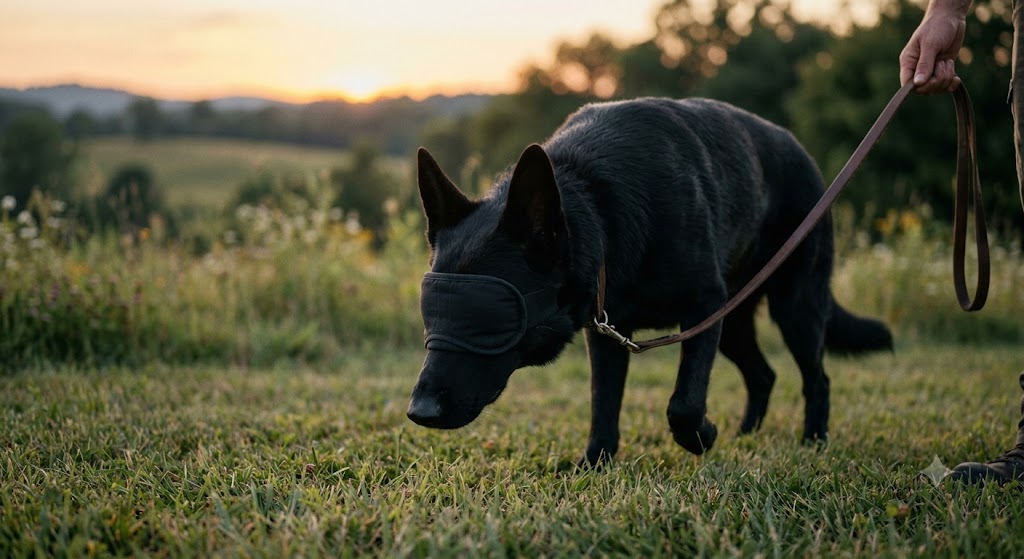
By introducing a blindfold—under strict conditions of cooperative safety—you aren’t depriving the dog. You are liberating them from the visual noise that dictates their anxiety. You are forcing an immediate, radical shift in how they process existence.
1. The Circuit Breaker of Sensory Reassignment
When the eyes go dark, the mechanical architecture of the reactivity loop shatters. If the visual trigger is removed, the conditioned emotional response—the explosion—has no physical anchor. The dog is thrown into a sensory vacuum, which forces an immediate, intense reawakening of their remaining senses: the auditory and, most importantly, the olfactory.
A dog’s olfactory cortex is vastly superior to our own, possessing up to 300 million scent receptors compared to our measly six million. Yet, acute visual reactivity constantly overrides this biological superpower. When a dog is trapped in a hyper-vigilant state, they scan the horizon with their eyes, completely ignoring the chemical reality beneath their feet. Deprived of sight, the dog is forced to drop their head, activate their nose, and read the environment through chemical signatures rather than surface-level optical threats. They stop reacting to what things look like, and finally start understanding what things actually are.
2. Trust as an Absolute Monopoly
Putting a blindfold on an apex predator is the ultimate subversion of traditional control. It is a profound psychological exercise in relief. In nature, a blind animal is a dead animal. Therefore, a dog who allows a handler to obscure their vision is yielding their primary defense mechanism directly to that human. They are signing over their autonomy in exchange for absolute safety.
This is where trust ceases to be a soft, nebulous concept and becomes an absolute operational monopoly. The dog’s internal dialogue shifts from “I must monitor the horizon for threats” to “I cannot see the horizon, therefore I must rely entirely on the tension of your hand, the tone of your voice, and the steady calm of your presence to navigate this space.” Every step forward under a blindfold becomes a joint venture in radical compliance and mutual reliance. The handler becomes the sole window through which the world is interpreted.
3. The Olfactory Handshake: Re-Engineering Socialization
The most revolutionary application of this experiment lies in the realm of conspecific socialization. Traditional dog-to-dog introductions are visual minefields. Two dogs spot each other from fifty feet away; they lock eyes, stiffen their spines, flag their tails, and accumulate intense muscular tension long before they ever make physical contact. This visual posturing is a primary driver of barrier frustration and leash reactivity.
By blinding the introduction, you bypass the visual posturing entirely. You force an olfactory handshake—an introduction based on chemical data rather than optical intimidation.
When two dogs meet without the ability to lock eyes or read tense, visual micro-expressions, the nature of the interaction changes completely. They cannot see the “threat display” of an erect tail or a hard stare. Instead, they are forced to meet through scent. They sniff the air, they read pheromones, they process age, health, and emotional status directly through chemical data. Because scent takes longer to process and digest than an instantaneous visual flash, the introduction naturally slows down. The dogs become grounded in reality rather than reacting to the illusion of visual defiance.
Methodological Note: Cooperation vs. Flooding
This protocol must never be implemented through force, coercion, or sudden sensory deprivation (flooding). The blindfold must be meticulously shaped using positive reinforcement. The dog must actively choose to place their snout into the apparatus, learning that the absence of sight does not equal the presence of danger, but rather signals a massive, predictable drop in environmental pressure.
The Radical Conclusion
The blindfold experiment isn’t just a tactical tool for extreme reactivity protocols; it is a philosophical mirror for the human handler. It exposes how heavily we rely on visual dominance to control our animals, rather than cultivating a deep, somatic connection. By blinding the dog, we stop managing their eyes, and we finally start communicating with their mind.