
We are obsessed with the “mind.” We’ve elevated it to a sacred status—a mysterious, ghost-like pilot steering a clumsy mechanical machine.
But what if we got it entirely backwards? What if the mind isn’t the driver of sentience?
What if the body is the driver, and the mind is merely a passenger describing the road?
This isn’t just semantic nitpicking. It’s a profound shift that reconnects consciousness with its true origin: the living organism.
The Error of the “Mind” abstraction
For centuries, philosophy (and often science) has treated the mind and body as separate, conflicting entities—the “ghost in the machine.” But if we strip away the abstraction, the “mind” isn’t actually a thing. It’s a conceptual label we use to describe what a body does.
A dog doesn’t choose to avoid danger through a moment of philosophical deliberation; its body, honed by millions of years of evolution, is already reacting to sensory data, activating adrenaline, and prioritizing self-preservation. When we label this “thought” or “instinct,” we obscure the fundamental reality: the biology is driving the process.
The capacity to feel—the raw awareness of existence, pain, or joy—doesn’t require an abstract conceptual mind. It only requires a living nervous system. It is a biological survival tool.
The Body as the Source of Being
To believe that the mind generates sentience is to put the cart before the horse. Sentience is embodied. It exists in the interactions between neurons, the hormonal feedback loops, and the sensory landscape the body inhabits. The brain itself—the supposed seat of this mind—is just another organ, entirely dependent on the physical input from the rest of the organism.
When we locate sentience in the “mind,” we disconnect it from reality. We turn it into a philosophical ghost.
But when we ground sentience back in the body, we accept that we are not separate from the world, observing it from afar. We are the interaction. The body is not a vehicle for sentience; the body is the sentient experience. It is the only thing that actually exists to feel.
Visual Concept: The Sensory Interface
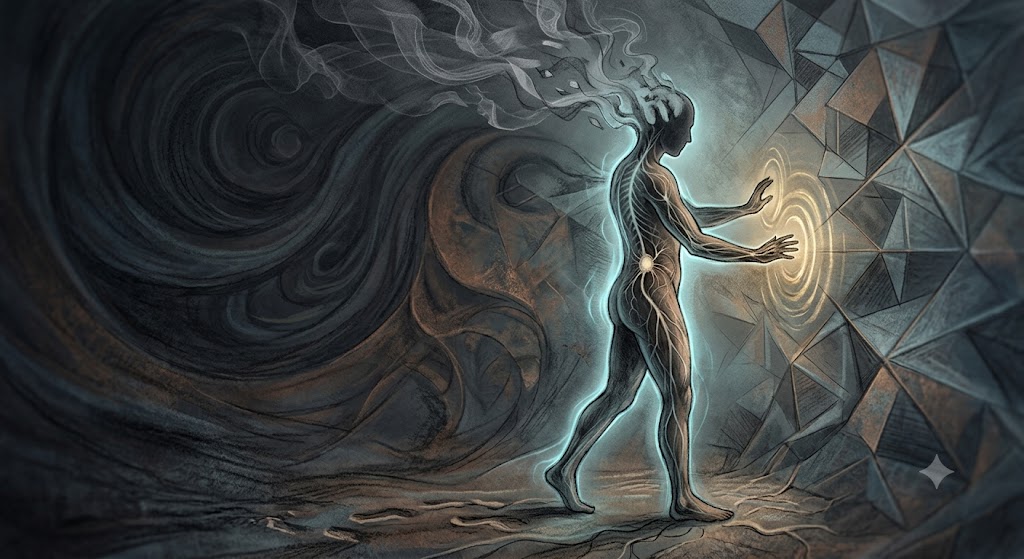
This abstract illustration represents the prompt’s concept of physically embodied consciousness. Instead of showing an anthropomorphic subject, the focus is the boundary of the body as the ultimate sensory interface.
The hand, composed of raw energy and radiating neural pathways, does not just touch the texture; it dissolves into the sensory reality it interacts with. This image visualizes that awareness isn’t a passive mental state, but an active, physical experience generated by the living, electrical biology connecting an organism to its world.