
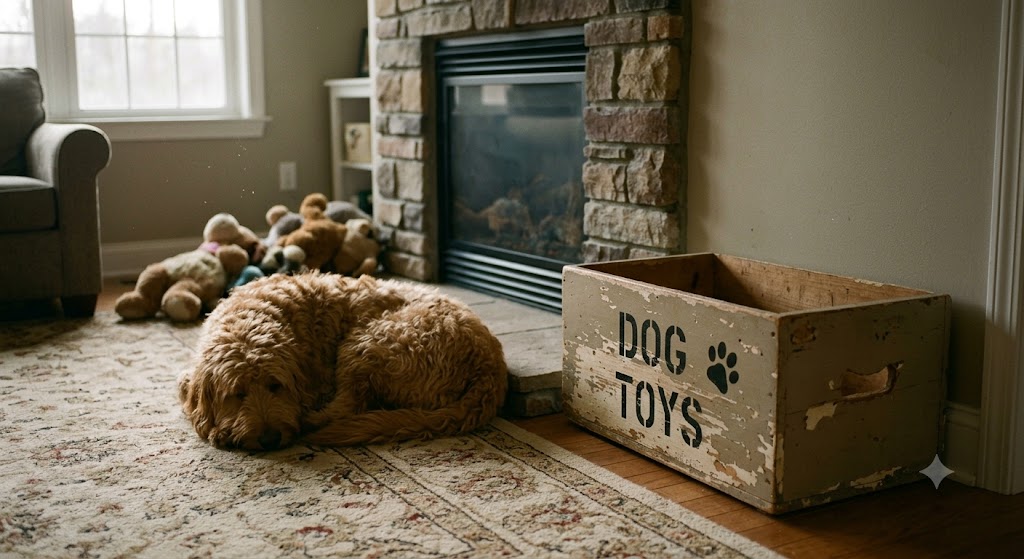
Walk into almost any modern dog-owning home, and you’ll see it: a basket overflowing with plushies, squeakers, and ropes sitting right in the living room. We’re told a toy box is a sign of a happy, spoiled, well-loved dog.
But if your dog is attacking guests at the front door, fence-fighting, or squaring off with the other animals in the house, that toy box isn’t a luxury. It’s a liability.
The Illusion of “Aggression”
When a dog explodes at a guest walking through the door, owners usually label it as aggression, territorial dominance, or protection. But if you strip away the labels and look at the functional behavior, what you are actually seeing is massive, uncontained excitement.
The real question isn’t “How do I punish this outburst?” It’s “Why does this level of hyper-arousal exist inside the house in the first place?”
One highly probable, completely overlooked culprit? The environment you’ve built.
Inside Is for Calm. Outside Is for Action.
Toys are triggers. They are physical manifestations of high arousal, chase, prey drive, and dopamine spikes. When a dog has 24/7 access to a toy box, the living room stops being a sanctuary of rest and becomes a high-octane playground. The dog is constantly swimming in a baseline of low-level anticipation, waiting for the next hit of excitement.
When the doorbell rings or a door opens, that pent-up, toy-induced arousal doesn’t disappear—it instantly redirects onto the guest. You wanted a happy home, but you accidentally built a pressure cooker.
If you want to play, be excited, and rev the engine? Great. Get out in the backyard, go for a hike, or go do something structured. But the threshold of your home should be a boundary of decompression.
The 3-Week Toy Fast
If your house is chaotic and your dog is reacting to every environmental shift, it’s time to change the environmental variables.
Try a simple experiment: Remove every single toy from the living space for the next three weeks.
Pack up the toy box and put it in a closet. Don’t leave random bones lying on the rug. Reset the indoor environment to represent one thing and one thing only: absolute calm.
Strip away the constant triggers of excitement, let the baseline cortisol and dopamine levels drop, and see if things finally calm down. You might be surprised to find out that your dog doesn’t actually have an aggression problem—they just have an environmental management problem.