“Advocate for your dog.” It’s one of the biggest, most overused buzzwords in modern dog training. It’s plastered across social media infographics, sold in seminars, and pitched by trainers as a vague, emotional duty. They sell it as a feeling—a state of mind where you shield your dog from the world like a protective guardian.
But marketing packages things in fluff. If we strip away the industry sales pitch and look at how behavior science actually defines the concept, “advocating” isn’t an emotional state. It is an active modification of the environment to preserve the behavioral and physical safety of an organism.
And the mechanics of doing it don’t care about species. Whether you are advocating for a scared dog or a scared child, the operational definition is exactly the same: you are standing between a vulnerable organism and an invasive environmental threat.
The Illusion of Social Obligation
We’ve all seen it: the flippant, hyper-social dog that rushes up to every stranger, practically demanding to be loved on. The exact same thing happens with highly extroverted, fearless children who will chat up anyone in a grocery store line. Because of them, society has developed a bad habit. People assume every living thing operates on an open-door policy.
But for the rest of the world—the nervous, the selective, the cautious—rushing into their space isn’t just rude; it’s an invasion.
Advocating means prioritizing the organism’s psychological safety over a stranger’s desire for a transient dopamine hit from forced interaction. It means recognizing that an individual has the right to say no to a physical approach.
The Consequence of Disrespect
Think about a terrified, non-verbal child. If a giant stranger marched up, cornered them, bent over them, and reached directly for their face, how would that child react? They would scream, kick, scratch, or bite.
Nobody would call that child “vicious” or label it an unprovoked “attack.” We would immediately recognize it for what it is: a desperate, fear-driven fight response to an overwhelming environmental threat. We would intuitively blame the adult for being completely devoid of boundaries and common sense.
Yet, when a dog uses the exact same behavioral strategy to remove an invasive threat, society labels it an “unprovoked attack” and blames the animal.
Marching up to a nervous organism and forcing physical contact is a profound display of disrespect. If you do this, you will likely be punished. And by “punished,” we mean in the purest behavioral sense: the organism will deliver a consequence that ensures you never repeat that behavior again. A bite or a scratch is an effective teacher. It is a lesson in respect that a human rarely forgets.
The Functional Parallel
When we look at these interactions through a radical behaviorist lens, the behavior of both the dog and the child serves the exact same function: it is a tool used to escape an aversive stimulus. When a human refuses to provide agency and forces a confrontation, the organism is backed into a corner and forced to play defense. The environment demands a reaction, and the organism delivers it to survive.
Consider the presentation of the nervous dog. When a stranger rushes into its immediate perimeter, hovers over its body, and forces physical contact, the environment becomes intensely threatening. If the dog responds with a bite or a sharp snap, the immediate result is that the startled human flees. Functionally, the threat is instantly removed from the environment. This is the definition of positive reinforcement—the dog experiences immediate relief, making a defensive strike the go-to strategy for future encounters.
The exact same mechanical sequence plays out with a scared child. When an invasive stranger corners them and attempts to grab or handle them against their will, the child strikes out, kicks, or screams. Just like with the dog, this defensive display forces the human to instantly step back and yield space. The aversive threat is removed, the child achieves safety, and the behavior is reinforced by the environment. In both cases, the blame belongs entirely to the human who ignored the boundaries of a living, breathing being.
The Disarmed Protocol: Giving Agency
So, what do we do instead? How do we respectfully meet a living, breathing being that is experiencing fear? The protocol is entirely universal.
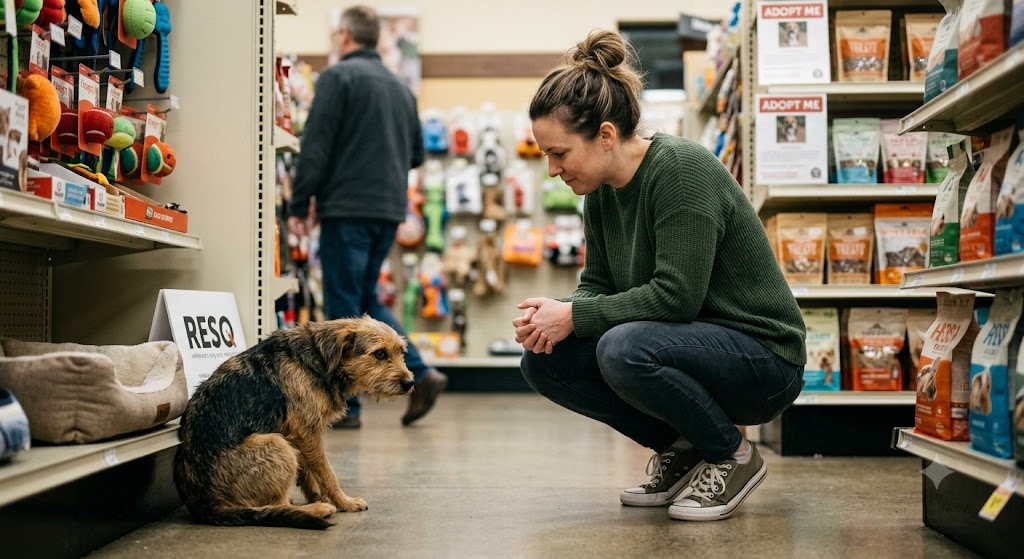
Whenever I meet a dog—or if I am interacting with a frightened child—I completely shift the dynamic. If my knees and back allow it, I squat down a few feet away, dropping my height so I am no longer towering over them like a predator.
I am calm.
I am inviting.
I am quiet.
I am intentionally disarming myself. By dropping my posture, keeping my distance, and staying still, I remove the pressure of my physical presence. I give the scared subject the space and time to get a bead on me, to process my presence, and to understand that I pose absolutely zero threat.
The onus is entirely on them. I am not forcing an interaction; I am offering an invitation. Come check me out, or don’t. It’s your choice. By giving them this agency and respect, I am rarely denied—and I have never been bitten by showing simple respect to a fellow animal.
A Sniff is Not an Invitation to Touch
When a dog chooses to come over for a thorough sniff, or a child steps closer to look you over, understand this clearly: this is not a green light for physical intimacy.
A sniff is an information-gathering mission. Some dogs just want to verify who you are, satisfy their curiosity, and walk away. Respect that. Other dogs will explicitly signal that they want affection by leaning in or softening their posture.
Either way, by remaining passive and respectful, you are acting as a safe, predictable presence. You are a positive consequence in that environment.
Organisms naturally repeat behaviors that lead to positive outcomes. When a nervous subject learns that approaching a human results in safety and autonomy rather than forced handling, that realization can become addictive. You can be the first step to freedom for an individual that has spent its life playing defense against a pushy world.
If you have a nervous dog and people ask to meet them, stop worrying about being polite to the humans. Look down the leash and advocate for the animal.
Ask the world to show some basic respect, step back, and let the dog make the choice.
The Marketing of “Advocacy” – It’s All Ass Backward.