
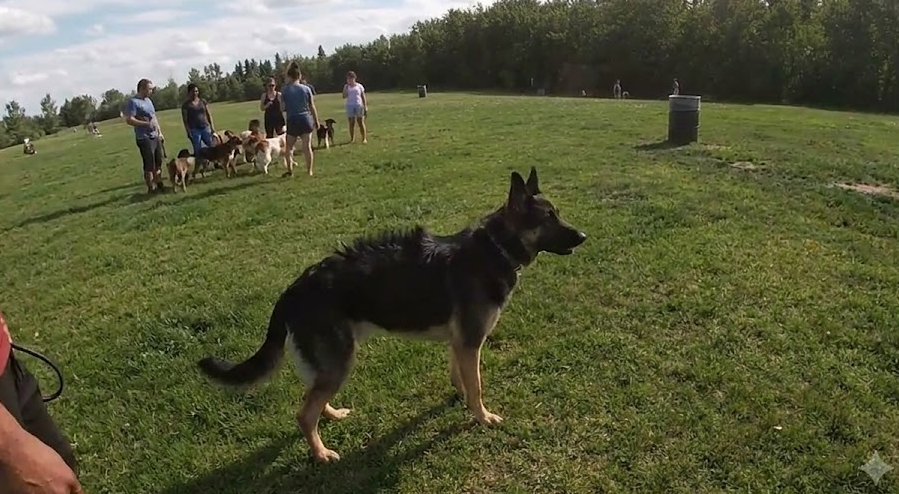
People don’t realize how they mirror their dogs – if you’re scared – your dog knows it from a distance and Luna is a case in point. The dog isn’t broken – I didn’t need to focus on the dog.
I see it all the time. An owner calls me out for an assessment because their dog is “reactive,” “aggressive,” or “out of control.” They are stressed, the dog is stressed, and they’re expecting a long, expensive training down the road.
But usually, the fix doesn’t take months. It takes an hour, costs $75, and has nothing to do with training the dog. And I didn’t tell them to get out of the dog park – they want to be in a dog park.
It has everything to do with training the humans.
Let’s look at an old case with a dog named Luna to show you exactly what I mean.
Part 1: The “Confident” Dog (The Setup)
I met Luna and her owners at a busy off-leash dog park. Right away, Luna’s hackles (the hair along her back) were standing straight up. She was stiff, hyper-alert, and watching every single dog like a hawk.
The husband looked at me and said, “She’s got this confidence now… moving forward with dogs, you know?”
They thought she was doing great. In reality, she was red-lining. She was in pure survival mode, totally overwhelmed by the chaotic environment.
But Luna wasn’t the real issue. The real issue was standing at the other end of the leash.
The wife was is scared – her operant conditioning has her in “oh shit” mode. Her arms were crossed tightly, her shoulders were hunched, and she was radiating pure anxiety. She was waiting for a disaster to happen.
Dogs are like mirrors. When Luna looked back at her owners, she didn’t see calm leaders; she saw a terrified human. Her brain instantly went: “My humans are scared, which means this place is dangerous. I need to keep my guard up to protect us.”
Part 2: The Video Flip (The Fix)
I didn’t spend the hour wrestling with Luna or pulling out fancy training tools. Instead, I pulled out my camera.
I recorded a quick video of the interaction, walked over to the owners, and showed them their own body language. I told them: “Chill out. Smile. Be happy… and just watch the dog.”
It sounds too simple to work, right? But watch what happened next.
The moment the owners stopped treating the park like a battlefield, the environment completely changed for Luna. The wife relaxed her shoulders, smiled, and started cheering Luna on in a happy, upbeat voice.
The result?
- The hackles went down. The permanent line of stressed-out hair on Luna’s back vanished.
- The stiffness disappeared. Luna started running with a loose, happy tail.
- Real play started. She actually joined in with the other dogs, doing her classic “tuck and roll” moves in the grass.
The Takeaway
Luna didn’t need a behavioral overhaul. She just needed her owners to stop broadcasting panic down the leash. When the humans changed, the dog changed.
If you are walking your dog while holding your breath, bracing for impact, and waiting for things to go wrong, your dog is going to match that energy every single time.
Sometimes, the best behavioral advice is simply to take a deep breath, smile, and let your dog see that you’ve got things under control.
