
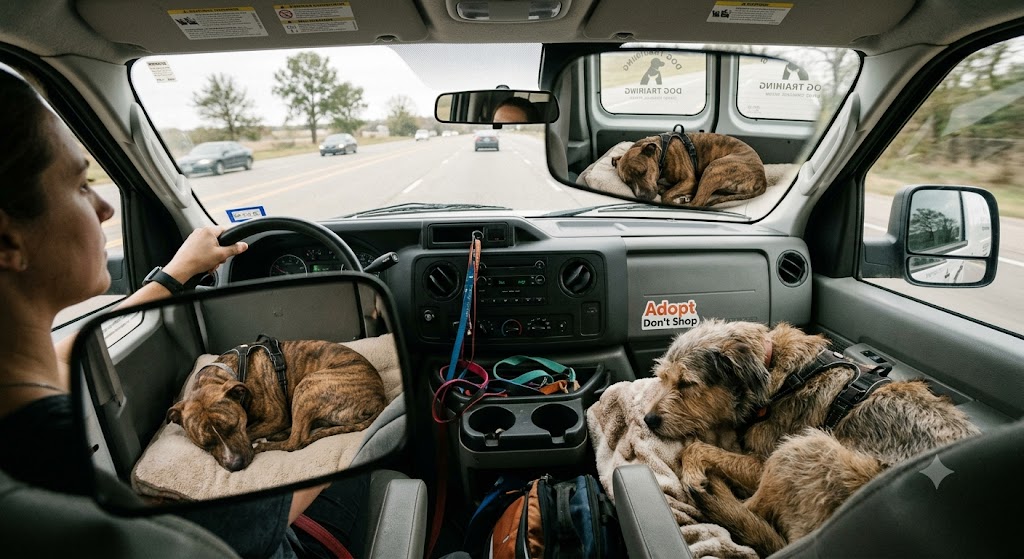
Let’s talk about car rides. For most dogs, the jingle of the keys means pure excitement. But for others, a moving vehicle triggers a complete and utter meltdown. They pace, they whine, they pant, or they bark like the world is ending.
I recently had a client with a Pitbull who did exactly that. Deep-set fears. The second the tires started moving, she would completely lose her sh*t.
Once in a while, I’ll take a client’s dog for a 24-hour period for some intensive socialization. This was one of those days. The owner dropped her off at 8:00 AM, and we had a packed schedule ahead of us.
The Setup
I loaded the Pitbull into the back of my van, and my own dog, Monty, rode shotgun in the passenger seat. We put the car in drive, and right on cue, Miss Pitbull started spiraling in the back.
But here is what happened next—or rather, what didn’t happen:
- The Role Model: Monty didn’t look back. He didn’t get tense. He just laid down and went to sleep on the way to the dog park. Her new dog friend wasn’t panicking; he was completely checked out.
- The Driver: I didn’t look back either. I didn’t say “It’s okay,” I didn’t yell, and I didn’t offer treats to soothe her. I just drove.
As a trainer, watching a dog go through that kind of intense distress is hard. Every instinct tells you to do something. But in that moment, intervention is the worst thing you can do. Fussing over her, talking to her, or trying to manage the panic would only validate and reinforce the chaos.
She needed to go through those emotions on her own.
The Turning Point
For about 15 to 20 minutes, it was a loud, heavy, emotional breakdown in the backseat. And then, suddenly… absolute silence.
I looked in the rearview mirror. She was sound asleep on the floor.
By refusing to feed into the panic, we let the emotional wave peak and break. Once those frantic emotions were finally dealt with and she reached a state of natural calm, the fear was effectively terminated. The cycle was broken.
We spent the rest of the day hitting up dog parks and pet stores, and she was fantastic.
The Proof is in the Pickup
The real test came the next morning when her owner picked her up. Shortly after driving away, my phone rang.
It was the owner, completely stunned. “Is this actually my dog?”
For the first time in her life, she had crawled into the backseat of his car and just went to sleep.
When dealing with deep-seated panic, we often try to micromanage a dog’s feelings, which accidentally stretches the anxiety out over months or years. Sometimes, the kindest and most effective thing you can do is set up a safe environment, provide a calm example, step back, and let them realize on their own terms that the world isn’t ending.