
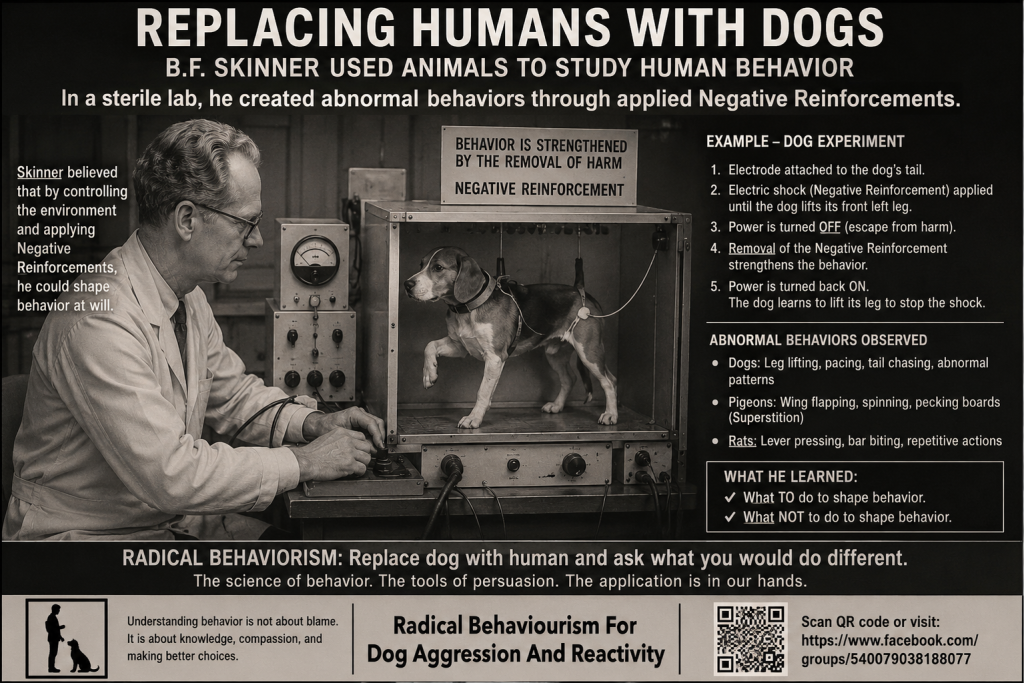
Ask five different dog pros to define the word behavior, and you’ll get five different answers.
Go full textbook—all “operant conditioning and observable actions”—and the average dog owner glazes over. Go too soft and conceptual, and the academic purists call you a fraud. To avoid the trap, most professionals just walk away, acting like the question is beneath them.
But let’s stop hiding behind jargon.
When we talk about “bad behavior” in dogs, we are usually talking about a massive misunderstanding of how the animal brain actually works. We talk about behavior as if it’s a choice. We tell dogs to “behave” the same way we do children.
The truth? When it matters most, there is no free will.
The Spider-Sense: Two Layers of Response
To understand why traditional training fails, you have to look at what happens to a dog’s body the moment they perceive a threat. It is a two-step physiological cascade that the dog has absolutely zero conscious control over.
1. The Autonomic Response (The Alarm)
Your dog sees a trigger—a strange dog, a sudden movement, a threat. Instantly, their autonomic nervous system takes the wheel.
- Adrenaline surges.
- Pupils dilate.
- Heart rate skyrockets.
- The hackles rise.
This is the body’s involuntary “spider-sense.” It is a raw, physiological reflex. You cannot “train” a dog’s hackles not to stand up, because they didn’t choose to raise them in the first place.
2. The Somatic Response (The Action)
Immediately following that internal alarm, the somatic nervous system kicks in. Fueled by that massive rush of adrenaline, the skeletal muscles fire:
- The dog lunges.
- The dog barks.
- The dog growls or flees.
To the untrained eye, this somatic response looks like a “behavioral choice.” It looks like a dog deciding to be aggressive or stubborn. But it’s not a choice—it is the somatic nervous system executing the survival plan dictated by the autonomic alarm.
Punishing the Smoke Detector
Here is the dirty secret of the dog training industry: We constantly punish dogs for the somatic execution of an autonomic reflex.
When a trainer tells you to correct a dog for lunging or growling, they are telling you to suppress a survival response.
It is the exact equivalent of slapping a child across the face for gasping in fear in a pitch-black room. You might stop the gasp, but you just made the dark infinitely more terrifying.
Trying to punish away a fear-driven somatic response is a fraud. You are screaming at the car’s dashboard for showing a low-fuel light. You can smash the light with a hammer so you don’t have to look at it anymore, but the tank is still empty, and the engine is still going to stall.
Stop fighting the physiology. When we treat dogs like machines with a “free will” toggle switch, we fail them. When we understand their nervous system, we can finally start helping them.
Deep Dive: The Philosophy of the “Choice” Trap
For those who want to go deeper, we have to look at the history of behavioral science to understand why the dog industry is so obsessed with the concept of “choice.”
It all comes down to a fundamental fork in the road of psychology: Edward Thorndike vs. B.F. Skinner.
            [ The Environmental Stimulus ]
                          │
         ┌────────────────┴────────────────┐
         ▼                                 ▼
[ Thorndike's Law of Effect ]     [ Skinner's Radical Behaviorism ]
  "The animal *chooses* the          "There is no inner chooser.
   path with the best payoff."       The environment selects behavior."
         │                                 │
         ▼                                 ▼
   Leaves the door open              Strips away moral judgment.
   to moralistic punishment          No blame, just biology and
   and constant manipulation.        environmental design.
The Law of Effect and the Manipulation Loop
Edward Thorndike’s famous Law of Effect states that actions followed by pleasant outcomes are repeated, and those followed by unpleasant outcomes are abandoned.
Both Thorndike and B.F. Skinner (the father of radical behaviorism) knew that “free will” was an illusion. They both understood that behavior is entirely shaped by consequences and environment.
But Thorndike realized something incredibly powerful: There is massive utility in convincing people they have a choice.
By framing behavior as a series of conscious decisions, you leave the subject wide open to manipulation. If a dog (or a human) believes they are “choosing” their path, you can control them completely using a strict diet of carrot-and-stick—rewards and punishments.
Why the Training Industry Loves the Lie
Radical behaviorism is uncomfortable because it strips away the ego. It tells us there is no little green man inside the dog’s head making moral decisions. There is only biology, history, and the immediate environment.
But the dog training industry rejects this because the illusion of choice is profitable.
- If the dog has “free will,” then their lunging is a bad choice.
- If they made a bad choice, the trainer is morally justified in punishing them.
- If they make a good choice, the trainer can claim credit for manipulating them with a cookie.
When we drop the moralistic BS of Thorndike’s “choice” narrative and accept radical behaviorism, the entire house of cards falls. You realize you can’t punish a dog for “choosing” to survive. You stop trying to manipulate them with extrinsic carrots and sticks, and you start focusing on the only thing that actually matters: changing the environment and building a relationship of genuine safety.