
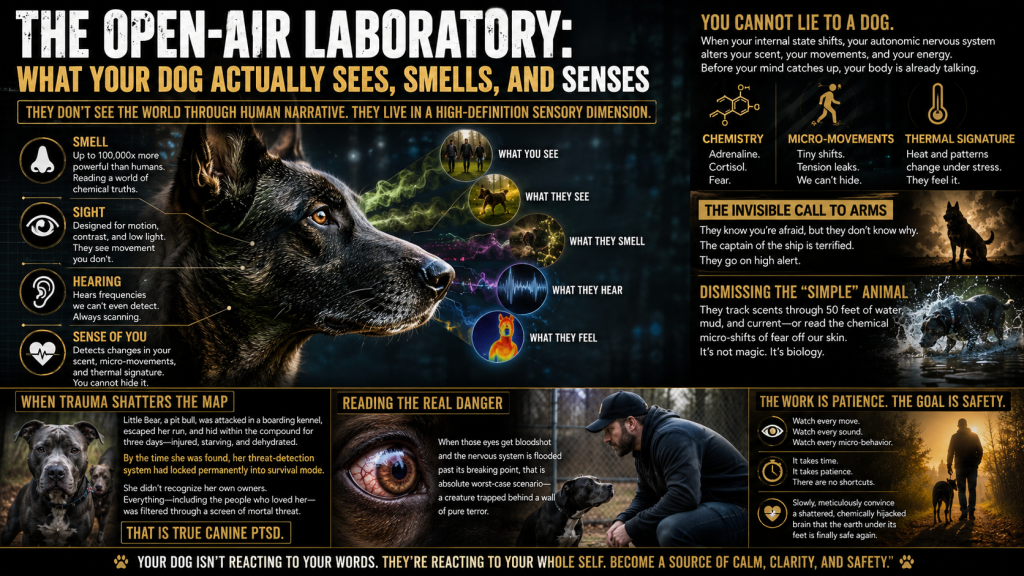
We like to think we are sophisticated leaders communicating with our dogs through clear human logic, spoken commands, and deliberate body language. But to a dog, we are an open-air laboratory.
They don’t view the world through human narrative. They live in a high-definition sensory dimension made of a shifting catalog of smells, raw chemical truths, and invisible data.
You Cannot Lie to a Dog
When your internal state shifts—when stress mounts or fear takes over—your autonomic nervous system alters your scent profile, your micro-movements, and your thermal signature. Long before your conscious mind catches up, you stink of adrenaline and cortisol.
We’ve all heard stories of people being endlessly amazed when a dog detects a medical emergency, flags a pregnancy, or reacts to an owner’s hidden anxiety. We act like it’s magic. It isn’t. It’s pure biology.
And from the dog’s perspective, this creates an immediate crisis:
- The Invisible Call to Arms: When your internal chemistry screams panic, the dog knows you are afraid, but they don’t know why. They don’t know you’re stressed about an incoming email or a traffic jam. They just know the captain of the ship is terrified, turning the room into an instant battle zone where they go on high alert.
- Dismissing the “Simple” Animal: Humans look at a creature capable of tracking a scent through 50 feet of water, mud, and current—or reading the chemical micro-shifts of fear off our skin—and still dismiss them as simple.
When Trauma Shatters the Map
This sensory intensity cuts both ways. When a dog goes through profound trauma, their ability to process safety breaks down entirely.
Take Little Bear, a pit bull who came to me as a client. She was already reactive when her owners put her in a boarding kennel for a vacation. While there, she was attacked by another dog, escaped her run, and disappeared. When she was finally found three days later, she hadn’t even jumped the fence—she had been hiding inside the compound the entire time, injured, starving, and dehydrated.
By the time she was recovered, her threat-detection system had locked permanently into survival mode. She didn’t even recognize her own owners. Her brain filtered everything in the universe—including the people who loved her—through a screen of mortal threat. That is true canine PTSD.
Reading the Real Danger
When you step into the pen with a dog like Little Bear, you aren’t the boss demanding compliance; you are a calm, steady variable in a hurricane. You watch every move, every sound, and every micro-behavior.
You watch the eyes. When those eyes get bloodshot and the nervous system is flooded past its breaking point, that is when you are looking at a dog at their absolute worst—a creature trapped behind a wall of pure terror.
Working through cases like that isn’t about dominance or quick fixes. It takes time, patience, and an absolute commitment to watching the physical data. You have to slowly, meticulously convince a shattered, chemically hijacked brain that the earth beneath its feet is finally safe again.