
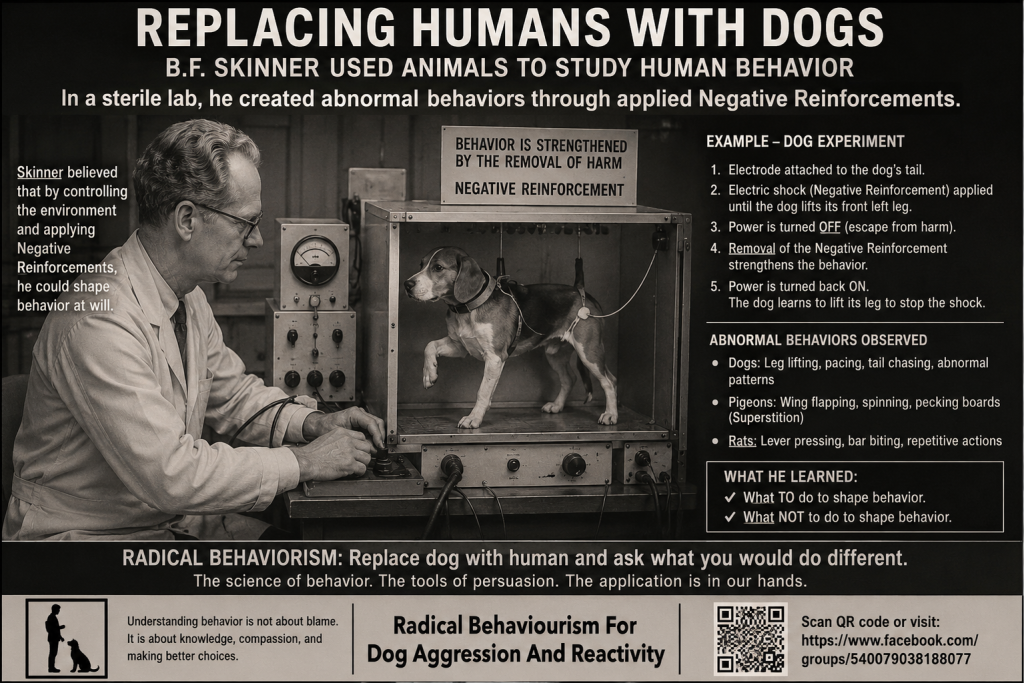
The documentary Self-Management of Behavior features B.F. Skinner detailing how human beings can bypass abstract notions of “willpower” and instead act as their own behavioral architects. By systematically manipulating environmental triggers, stimuli, and consequences, an individual can engineer personal change. However, when these rigorous behaviorist methodologies are extrapolated from academic theory to domestic child-rearing and pet management, they reveal stark ethical complications.
Parental Intervention, Punishment, and Parallels to Dog Training
In applying strict operant conditioning to human and animal rearing, a common trajectory emerges when behavioral control fails:
- The Interventions: Parents or pet owners attempt to systematically shape a subject’s actions using tightly controlled reinforcement schedules. However, when unwanted behaviors persist due to poor environmental design or inconsistent enforcement, strict behaviorists often resort to aversive control or punishment.
- The Dog Owner Parallel: Just as rigid behavior modification programs on children can rely on isolating or suppressing undesirable actions, pet owners frequently utilize heavy-handed correction techniques (such as alpha-rolling, shock collars, or strict isolation) to suppress unwanted canine behaviors like chewing, barking, or leash pulling.
- The Shared Result: When these mechanical interventions fail to yield a “perfect” subject—often because the environment itself is mismanaged—both the troubled child and the misunderstood dog face the ultimate rejection: an attempt at rehoming or institutional displacement. The living organism is treated as a defective product that failed to respond correctly to programming.
Manufacturing Abnormal Behaviors and Token Systems
Skinner’s framework frequently relied on introducing controlled deprivation or artificial token economies to measure how subjects would work to correct the very states the experimenter engineered.
- By structuring environments down to the micro-level, behaviorists could inadvertently provoke neurosis or distress (abnormal behaviors) by forcing subjects to navigate rigid, unnatural systems to secure basic needs or approval.
- The use of token systems—awarding tokens or points for compliant behavior that could later be exchanged for privileges—turned natural human relationships into transactional labor. Affection and security were no longer freely given; they had to be earned through automated compliance.
The Ultimate Paradox: Re-entering the Matrix
The most profound irony of B.F. Skinner’s life’s work is the paradox of the matrix. Skinner spent his career attempting to expose how humans are blindly shaped, controlled, and automated by cultural and environmental contingencies—effectively mapping out the invisible “matrix” of modern social conditioning.
Yet, to prove his theories and manage outcomes, he had to construct an even tighter, more artificial matrix around his subjects (whether pigeons, students, or his children via controlled environments). For Skinner to champion human liberation from accidental control, he paradoxically had to advocate for deliberate, totalizing scientific control. To achieve true behavioral freedom, his philosophy required locking the subject deeper inside an engineered system—proving that to escape external manipulation, one must willingly step into someone else’s laboratory.

This video is relevant because it features archival footage of B.F. Skinner directly presenting the principles of behavioral self-management and environmental control discussed in the documentary.