
We’ve all seen it: a dog starts gaining weight out of nowhere, acts sluggish, loses interest in play, or suddenly seems anxious, fearful, or reactive for no apparent reason.
Too often, owners are told it’s just a stubborn training issue, a lack of exercise, or plain old aging. But before you blame the training plan, you need to check the engine.
Underneath many sudden behavioral shifts and physical slumps is a sneaky culprit: hypothyroidism (an underactive thyroid gland). When the thyroid slows down, it drags the entire metabolism down with it—affecting everything from energy levels to brain chemistry and emotional regulation.
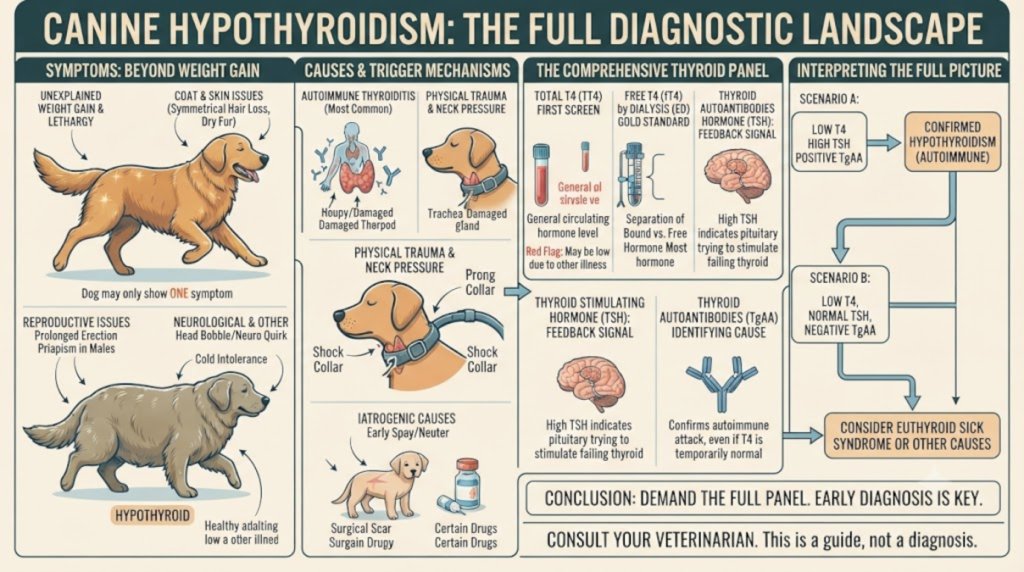
Crucially, your dog might only show a single symptom. You do not need a massive checklist of problems for the thyroid to be the culprit. Sometimes, a bizarre head bobble, a weird allergic flare-up, or a single behavioral change is the only glaring red flag waving at you.
If you notice even one of these signs, it is well worth getting a veterinary thyroid panel run.
Red Flag Signs of Canine Hypothyroidism
- Unexplained Weight Gain: Piling on pounds even when food intake hasn’t changed (or is actually restricted).
- Lethargy and Sluggishness: A dog that used to have drive and stamina is suddenly moving in slow motion or sleeping the day away.
- The “Tragic” or “Dull” Expression: A sleepy, puffy face with drooping skin folds and a dull look in the eyes.
- Coat and Skin Changes: Dry, brittle fur, symmetrical hair loss (especially on the flanks or tail, often called a “rat tail”), and recurrent skin infections.
- Unexplained Allergies: Sudden, stubborn skin flare-ups, chronic ear infections, or itchy paws that pop out of nowhere or refuse to respond to standard allergy treatments because the immune and skin barriers are tanking.
- Cold Intolerance: Seeking out heat vents, blankets, or warm spots obsessively because they can’t regulate their body temperature.
- Neurological Quirks (Head Bobble): Less common, but a strange, unexplained head bobbing or tremors can occasionally pop up due to how low thyroid levels affect nerve and muscle function.
- Reproductive Issues (Long-Lasting Erections): In intact males, hypothyroidism can sometimes cause unusual hormonal quirks, including prolonged, persistent erections (priapism) due to a breakdown in normal neurological and circulatory tone.
- Sudden Behavioral Shifts: Uncharacteristic fearfulness, sudden aggression, or severe anxiety in a dog that was previously stable. (When the physical body is failing or in pain, behavior breaks down).
What Actually Causes Canine Hypothyroidism?
The thyroid gland doesn’t just give up for no reason. In dogs, hypothyroidism usually falls into two main buckets: the immune system attacking the gland, or something physically damaging and disrupting the delicate hormonal feedback loop.
- Autoimmune Thyroiditis (Lymphocytic Thyroiditis): This is the cause in the vast majority of cases (roughly 50% to 80%). The dog’s own immune system mistakes the thyroid gland for an invader and slowly destroys the tissue until it can no longer produce enough hormone. It has a strong genetic and hereditary component.
- Idiopathic Thyroid Atrophy: In these cases, the normal thyroid tissue slowly wastes away and gets replaced by fat and connective tissue. We don’t always know the exact trigger, but it results in a gland that simply stops working.
- Physical Trauma and Neck Pressure: The thyroid gland sits right in the throat, wrapped around the trachea. High-impact, repetitive physical trauma to the neck—such as the sudden jolt of a correction on a prong collar, choke chain, or the misuse of an electronic training collar (shock collar)—can cause direct physical damage, local inflammation, and scarring of the thyroid tissue, potentially compromising its function over time.
- Early Spay and Neuter: Hormones are deeply interconnected. Removing the gonads (ovaries or testicles) alters the entire endocrine network, including the pituitary-thyroid axis. Early spaying and neutering—before the endocrine system is fully matured—has been heavily linked in veterinary literature to an increased risk of thyroid dysfunction down the road.
- Dietary and Environmental Factors: Chronic exposure to certain toxins, heavy metals, or endocrine-disrupting chemicals in the environment can interfere with normal hormone synthesis. Additionally, diets deficient in proper trace nutrients (or unbalanced raw diets with excessive thyroid tissue inclusion, which can trigger feedback confusion) can play a role.
- Congenital Hypothyroidism: Rare, but some puppies are born with a genetic defect where the thyroid gland fails to develop properly from birth.
The Blood Tests: What They Are and Why They Matter
When you go to the vet, you want more than a quick glance. A complete thyroid evaluation looks at several different markers. Here is what can be tested and what those tests actually mean:
- Total T4 (tT4):
- What it is: A measurement of the total amount of thyroid hormone circulating in the blood.
- Why it’s done: It’s usually the first screening test. If this number is high or normal, hypothyroidism is unlikely. If it’s low, it raises a red flag—though it’s not a final diagnosis on its own, because other illnesses and medications can temporarily lower T4.
- Free T4 (fT4) via Equilibrium Dialysis (ED):
- What it is: Measures the fraction of T4 hormone that is floating free and active in the blood, unbound to proteins.
- Why it’s done: This is much more accurate than Total T4 because it isn’t easily thrown off by other non-thyroid illnesses.
- Thyroid Stimulating Hormone (TSH):
- What it is: A hormone produced by the brain telling the thyroid gland to work harder.
- Why it’s done: If the thyroid is failing, the brain screams louder by pumping out more TSH. High TSH combined with low T4 is a classic signature of hypothyroidism. (Note: About 25% of hypothyroid dogs can have normal TSH levels, so it shouldn’t be used alone).
- Thyroid Autoantibodies (Anti-TgAA):
- What it is: Tests for the immune system attacking the dog’s own thyroid gland (an autoimmune disease called lymphocytic thyroiditis, which causes most cases of canine hypothyroidism).
- Why it’s done: It identifies why the thyroid is failing and can catch early autoimmune destruction before hormone levels even drop too low.
The Bottom Line: The Test Suite You Should Actually Demand
Don’t settle for a single, cheap in-house screening test if you suspect a problem. To get a clear, reliable picture, your vet should send out a comprehensive panel.
Insist on a Full Thyroid Panel that includes:
- Free T4 by Equilibrium Dialysis (fT4 by ED)
- TSH
- Endogenous cTSH and Autoantibodies (Anti-TgAA)
If your dog’s behavior or body is changing overnight—even if it’s just one weird symptom—don’t guess. Run the labs. Fixing a medical baseline is always step one before trying to fix anything else.