
We love to flatter ourselves about free will. We sit back, sip our coffee, and think we are the absolute captains of our fate—making conscious, deliberate choices every second of the day. And we love projecting that exact same comforting fairy tale onto our dogs. When a dog makes a split-second decision to lunge, chase, or freeze, the conventional training crowd starts wringing their hands about the dog’s moral agency, intent, or “choices.”
It is complete nonsense.
When you strip away the romantic fluff, the brain is not a magical decision-making organ blessed with free will. It is an ultra-sophisticated prediction machine. And once you look at it that way, the entire concept of “free will” starts looking like a nice story we tell ourselves after the fact.
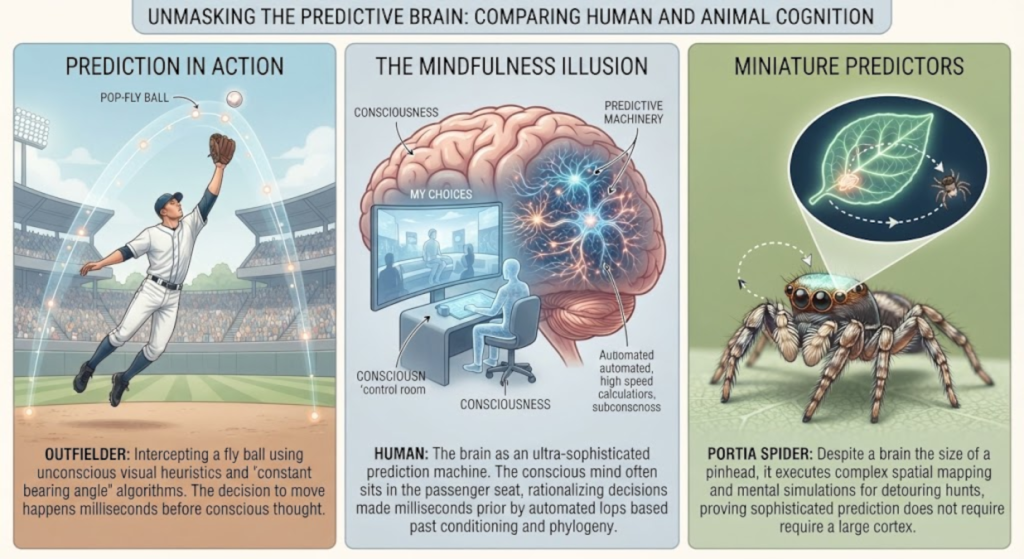
Think about a dog chasing a frisbee. Watch an experienced border collie track a disc cutting through the wind. People look at that and say, “Look at how smart he is, making a choice to cut left!” But the dog isn’t sitting there pondering geometry. He is doing exactly what a major league outfielder does when tracking a high pop fly. He locks his eyes on the object and runs along a path that keeps the visual angle steady, letting physics and his nervous system do the heavy lifting. He isn’t consciously calculating velocity and wind resistance; his predictive brain is running an automated interception algorithm. The movement happens before conscious thought even clocks that the toy is in the air.
If you want to blow your mind even further, look at Portia—a tiny jumping spider with a brain the size of a pinhead. This little arachnid hunts other spiders by planning complex, multi-step detours. It will deliberately crawl out of sight, navigate around obstacles it can no longer see, and ambush prey from a blind spot. If a microscopic spider can run advanced predictive spatial mapping without a mammalian cortex, what does that say about our grand illusions of conscious control?
Here is the hard truth that the moralizing dog-training mob will never understand: by the time you or your dog feel like you’ve made a “conscious choice,” your predictive brain has already settled the matter milliseconds prior based on evolutionary history, past conditioning, and environmental cues. The conscious mind just sits in the passenger seat, staring out the window, and invents a nice little story about how it’s steering.
Understanding this completely changes how you look at animal behavior—and human behavior, for that matter. Once you stop looking for phantom acts of “free will” and start looking at environmental variables and predictive loops, the whole game changes.
What part of this predictive machinery should we break down next—how trauma permanently rewires a dog’s expectation of danger, or how we can use these exact mechanics to reshape behavior without the emotional hand-wringing?