
When a body breaks down completely, the medical establishment often prefers a neat
narrative: treatment, recovery, or closure. But my 2020 didn’t offer a clean arc. It was a
descent into catastrophic organ failure, surgical malpractice, and institutional abandonment
that left me a medical ghost—told I was terminal, left entirely on my own, and forced to figure
out how to survive in a body that no longer worked.
It started innocently enough in mid-January. I began vomiting blood and passing large black
bowel movements. Like a typical Gen-Xer, my first instinct was to walk it off. I found out the
hard way that you cannot walk off massive internal bleeding. By mid-February, I was passing
out from blood loss while simply walking through the living room, crashing into whatever
was in front of me. I’d wake up to my dog, Monty, freaking out and biting my legs, trying to
drag me back to consciousness. Along the way came multiple concussions, cuts that didn’t
even bleed, busted ribs, and more—all the brutal physical fallout from suddenly dropping
where I stood.
At the hospital, they suspected a bleeding ulcer, but their machines were down. They gave me
a blood transfusion and sent me home. Two weeks later, I was passing out again.
By the end of February 2020, an endoscope finally revealed the culprit: a 4 cm deep crater
bleeding ulcer in the duodenum, right outside the pyloric sphincter. They tried to clamp it and
failed. For weeks, I lived on a relentless loop—bleeding internally until I passed out, rushing
to the hospital for blood, IVs, and iron transfusions.
While the world locked down for a pandemic in March 2020, my internal world was
collapsing. An endoscope showed thickening of the stomach lining; a doctor guessed stomach
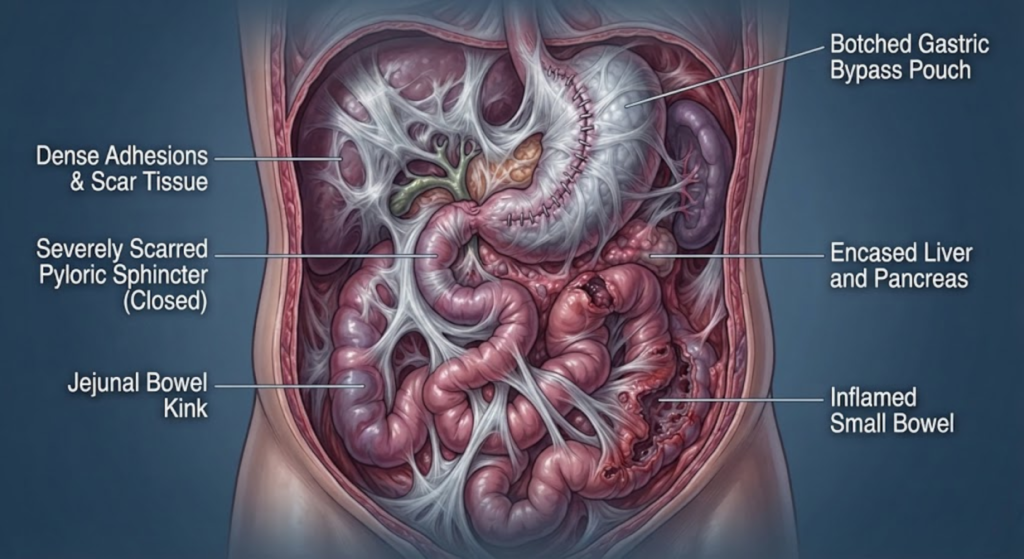
cancer, but he was dead wrong. The ulcer had destroyed 90 percent of my stomach and
completely scarred my pyloric sphincter shut. The scar tissue tore through my duodenum,
ileum, and most of my jejunum, creeping up to encase my liver, spleen, gallbladder, and
pancreas in up to 30 percent scar tissue—all of which went completely unnoticed until
September.
By mid-March, my stomach was sealed shut. I was still bleeding, but now I was starving and
dehydrating to death simultaneously. I could eat and drink, but the food had nowhere to go. It
would sit in my stomach for a day until it came up in one violent, full-sweep purge. You learn
quickly how much fluid the average human stomach can hold when it has nowhere else to
empty.
In mid-April, epinephrine injections finally stopped the bleeding ulcer. But just a few weeks
later, the damage caught up: the ulcer ruptured, leaving a 4 mm hole in my duodenum and
plunging me into sepsis. There is pain that hurts, and then there is pain that fundamentally
alters who you are.
When I finally reached the hospital, the surgeon walked into my room with brutal honesty,
admitting he’d drawn the short straw, had no game plan, and didn’t have the foggingest idea
what he’d find inside. He gave me a 10 to 20 percent chance of survival, offering to drug me
up and let me die if I preferred. I told him I was still here. By the end of April, I was
dangerously skinny, and he struggled to find enough fat in my abdominal cavity to patch the
hole in my duodenum.
The bleeding stopped, but the starvation didn’t. Through June and July, I was running to the
hospital every week for IV fluids. Nurses would burn through their allowed two stick attempts
before having to call the blood bank because my veins had collapsed from chronic
dehydration. I’d have to contort my body just so they could salvage a vein in the back of my
arm.
Meanwhile, the pandemic hospital environment was a surreal mix of administrative lunacy
and incredible nursing staff who actually cared while the doctors were checked out. They
were still trying to give me oral laxatives and enemas in August 2020, completely oblivious to
the fact that I hadn’t had a bowel movement or retained food since mid-March.
Then came mid-August, and the surgeon touted as “the best of the best.” I suggested she just
poke a hole and look around first, but she insisted she knew what she was doing. She opened
me up, saw the catastrophic wall of scar tissue across my organs and intestines, and panicked.
Instead of an exploratory peek, she botched a gastric bypass. I woke up with a nasogastric
tube—which shouldn’t have been necessary if the bypass worked—stuck in a regular room
instead of the ICU. Two days later, a fluoroscope showed her sutures were leaking and the
bypass was already sealed shut. I was septic for the second time that year. Did she fix it? No.
For two and a half weeks, I was told her failed sutures would “magically pop open on their
own.” She left a man with a belly full of trapped, stagnant waste to rot in a room.
In mid-September, a rogue gastroenterologist broke protocol and forced the bypass open via
endoscope. He looked at my case, told me specialists across Canada and beyond were
watching it, and asked the only question that mattered: How the fuck are you still alive?
When the bypass finally opened, a new hell began. Because the surgeon left a permanent kink
in my bowel between the bypass and my scarred pyloric sphincter, bile pools in that trapped
section like a two-liter pop bottle under intense pressure. On bad nights, while I’m asleep, that
pressure releases. I wake up choking, drowning in corrosive bile aspirated into my lungs,
forced to frantically stick my fingers down my throat to manually vomit my guts out before I
suffocate or pass out from lack of oxygen. At my worst, weighing 130 pounds, I purged over
two gallons of fluid at a single time—violently forcing the pressure past that surgical kink. The
physical strain has been so absolute that I now deal with hernias on both sides that pop out
every time I heave.
The nurses watched me puke two liters at a time in horror. The doctors wouldn’t even
acknowledge it, knowing that admitting my stomach no longer worked meant admitting they
severed my vagus nerve and ruined my life during their botched operation.
On Halloween 2020, that same surgeon walked into my room to officially eject me. Terminal,
she called it. There’s nothing more we can do. Terminal doesn’t mean you’re going to die
tomorrow; it means they are washing their hands of you.
I left that hospital alone. I shouldn’t be alive. After what I went through, it would have been so
easy to just slip away—bleeding out or dying of dehydration, both of which are quiet, painless
exits. But I stayed.
Living since October 2020 without a safety net means managing a body that lacks the primary
areas of absorption. Trying to recover from massive dehydration when your gut can’t absorb
water is like bailing out a sinking ship with a sieve. The constant acid exposure from bile and
vomiting has wrecked my teeth and gums, drawing casual mockery from people who have no
idea what it takes just to keep breathing. Worst of all, it stripped me of my life’s work—leaving
me too physically weak to work with dogs anymore.
I didn’t have anyone standing in my way—telling me that I can’t do something, or letting me
do that for you because you’re not capable. Life and death was completely on my shoulders.
Live or die was my decision.
You don’t know how tough you can be until you have to be. When you’re near death on the
floor, you’ve really only got two choices: stay there and die, or get your ass off the floor and try
to live.
And I firmly believe that good intentions kill more patients than you can
understand.