
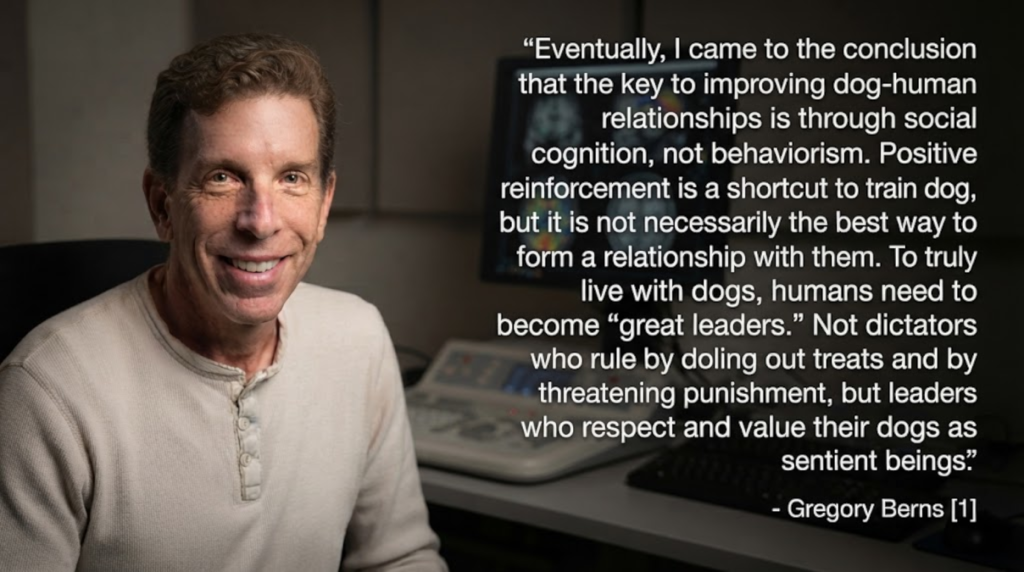
“Eventually, I came to the conclusion that the key to improving dog-human relationships is through social cognition, not behaviorism. Positive reinforcement is a shortcut to train dogs, but it is not necessarily the best way to form a relationship with them. To truly live with dogs, humans need to become “great leaders.” Not dictators who rule by doling out treats and by threatening punishment, but leaders who respect and value their dogs as sentient beings.”
That is Dr. Gregory Berns talking, the man behind the famous Canine Cognition Project, where dogs willingly hop into MRI machines so we can watch their brains light up in real time. Social cognition focuses on the internal mental processes an animal uses to perceive, process, and navigate social relationships, while behaviorism studies outward, observable actions driven by environmental interactions and conditioning.
Berns wants us to look past simple training tricks and treat dogs as thinking, feeling beings. But when you take his work out of the dog training world and look at what he’s actually staring at inside that scanner, it forces us to ask a much bigger, slightly uncomfortable question: Does a dog—or a human, for that matter—actually have free will? Or are we just sophisticated biological machines reacting to the world around us?
To figure this out, we have to look at what’s really happening under the hood.
The Illusion of the “Self”
We like to think there is a little captain sitting behind our eyes. You know the guy—the conscious “you” that calmly weighs options, makes deliberate choices, and decides whether to eat the apple or the donut, or whether to trust a trainer with a prong collar.
But Berns, in his work on how the brain constructs reality, points to something entirely different. The brain isn’t a magical command center. It’s a prediction machine. It is constantly taking in past experiences, current smells, sights, and sounds, and running lightning-fast calculations to guess what will happen next.
When you look at a dog’s brain light up on an MRI screen when it smells its human, you aren’t seeing a tiny soul making a free, uncaused choice to love. You are seeing a biological system doing what it was built to do: recognizing safety, predicting survival, and responding to chemistry and history.
And here’s the kicker—dogs aren’t the only ones running on autopilot. We are, too.
The Brain Moves First
For centuries, we’ve believed the story that the mind leads and the body follows. We think, I have decided to do X, and then our body does it.
Neurology has spent decades poking holes in that comforting story. Brain scans show that the neural machinery starts firing before we are ever consciously aware of making a choice. By the time your conscious mind says, “Aha! I’ve made a decision,” your brain has already done the heavy lifting, driven by genetics, past conditioning, and environmental triggers.
Think about when the hair stands on the back of your neck—you can’t help it. Danger is imminent, and your mind is playing catch-up trying to figure out what’s going on. So why are you punishing your dog for upping their hackles? They can’t control those hairs either.
Think about it like an automated smart-home system. The thermostat reads the temperature, a bunch of hidden wires click, and the furnace turns on. You didn’t consciously negotiate with the furnace; the system just executed a sequence based on inputs.
If our brains are biological prediction machines running on past data and environmental input, where does “free will” actually live?
The Trap of the “Great Leader”
This brings us right back to Berns’s quote. He argues that we shouldn’t treat dogs like mechanical input-output boxes (the strict behaviorist trap), but should instead become “great leaders” who respect them as sentient beings.
He’s right that handing out treats for compliance is a cheap substitute for a real relationship. But if we dig deeper into the neuroscience Berns himself studies, the idea of a “leader” making free-willed choices gets a bit blurry. If a dog’s behavior is the product of its biology and its history, and our desire to be a “good leader” is the product of our biology and history, then we aren’t two independent free agents gracefully choosing to connect.
We are two biological systems colliding in a room, trying to figure out if it’s safe to lower our guard.
Rewriting the Narrative
So, does an MRI prove free will or determinism?
If you’re looking for a magical, ghost-in-the-machine free will—the ability to act completely detached from your biology, your past, and your environment—the MRI doesn’t find it. It finds wiring, chemistry, and predictable loops of cause and effect. It reveals that we are, in many ways, biological machines navigating a complex world.
But here is why that shouldn’t depress you. Realizing that we—and our dogs—are driven by deep, subcortical wiring changes everything about how we live together.
When a dog reacts with fear or aggression, they aren’t exercising some malicious “free will” to be a bad dog. They are a prediction machine whose history has taught them that the world is dangerous. When you realize that, the anger evaporates. You stop trying to force compliance through threats or bribe it with treats, and you realize the only way to change the equation is to change the environment.
You stop fighting the machine, and you start offering peace. And in a completely determined universe, that might just be the only choice that actually matters.