
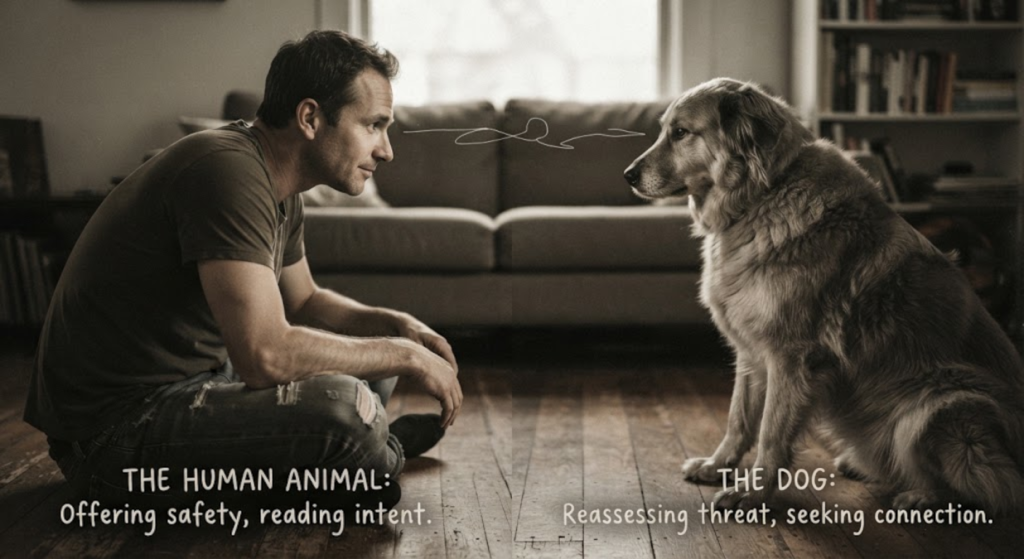
“I don’t trust my dog.” That is the number one thing I hear from owners, and it tells the entire story. Without trust, a relationship cannot exist. And if you’re not willing to offer up respect, you will never gain trust. It all starts with respect.
Doling out punishment and manipulation with treats is not respect. And how does anyone learn respect if they never experience it? If all you offer is disrespect, then that’s all the animal learns.
We live in a deeply transactional culture. People want immediate compliance, a quick fix, and a predictable return on emotional investment. We treat relationships—and animals—like appliances: plug them in, press a button, and expect them to perform. But if you want to see the true side effects of transactional relationships, all you need to do is look at the outcome for the dog.
When a dog’s world is built entirely on transactions—where obedience is bought with treats or beaten into submission with aversive tools—they never learn safety. They learn risk management.
Real rehabilitation cannot begin until you change the emotional landscape of the room. As James French wisely noted, when an animal finds peace in your presence, they will come to trust you. Offering a state of calm, a state of peace in the confines of chaos, is the ultimate form of respect to any animal, dog or human.
Think about what happens when you approach a backyard behind a gate where a dog is locked in barrier aggression. Many of the dogs behind that fence put on a good show; that noise and fury is all they’ve ever learned to do. But if you stand there completely calm, realizing it’s not a big personal deal, the dynamic shifts. The dog can only sustain that panicked state for so long. At some point, they realize their usual routine isn’t working, and they give up. They back away from the gate, unsure of what is going to happen next.
That is the moment operant conditioning breaks. That is the point of confusion that forces an animal to look for a different path.
When you step past the gate, you are offering a simple, undeniable truth: my intention is to calmly enter your space—now show me yours. By squatting down, you drop your physical profile, remove your predatory height advantage, and signal fundamental respect. You strip away the human ego and stop being a variable they have to manage.
Getting a dog to like you is easy. Handing out high-value food and playing the safe bubble is a cheap trick. But getting the dog to like—and trust—the world? That’s the real work. And it will never happen if they don’t first experience genuine respect and safety from you.
When we view behavior through the lens of radical behaviorism, we realize that humans and animals operate on the exact same foundational mechanics. We are shaped by our histories, driven by environmental contingencies, and reacting to pressure. When you stop projecting human expectations onto an animal and start respecting their actual biology, you stop punishing them for being who they are.
Trust isn’t something you demand, and respect isn’t something you command with a prong collar or a heavy hand. It is forged in the quiet spaces, earned through unshakeable consistency, and solidified the moment an animal realizes they don’t have to defend themselves against you anymore.