
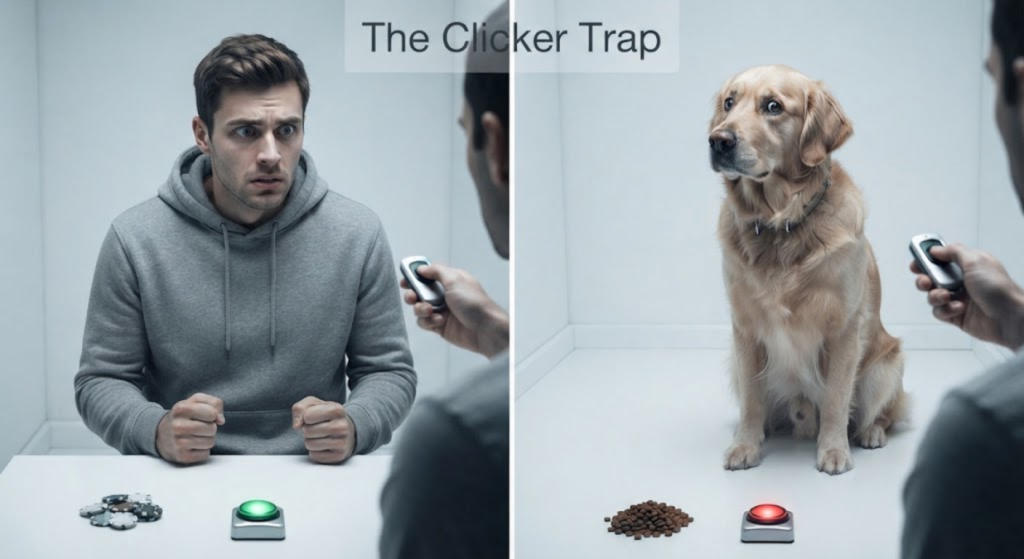
In the modern dog training world, the clicker is marketed as the ultimate harmless, force-free miracle tool. You wait for a dog to sit, you click the exact millisecond their rear hits the floor, and you hand over a treat. To the average owner, it feels like teaching a helpful skill.
But if we strip away the marketing fluff and look at it through the cold, hard lens of behavioral science, a clicker isn’t a harmless toy. It is a dangerous psychological trap.
How the Clicker Turns Behavior into a “Trick”
A true behavior is an organism’s continuous, fluid interaction with its environment. It shifts organically based on context, drives, and the immediate situation.
When you introduce a clicker coupled with food, you hijack that fluidity through operant conditioning. The click acts as a precise marker signal, instantly locking in a micro-movement. Because of a fundamental rule in the nervous system—your very first reaction or consequence to something will be your forever reaction—that initial click-and-payout loop burns a permanent neural pathway.
Instead of teaching an animal how to read and navigate the real world, the clicker chops behavior into sterile, unnatural fragments. The animal stops interacting with the environment organically and starts performing a frantic, mechanical loop just to trigger the reward. They aren’t learning; they are performing a trick.
Why the Damage Is So Hard to Undo
When clicker training goes sideways and leaves you with an anxious, hyper-fixated dog, unravelling the fallout is notoriously difficult. There are three main reasons why:
- The Imprint Is Permanent: Because of operant conditioning’s first-reaction rule, that initial dopamine-soaked snapshot wired into the nervous system during training can never truly be erased.
- The Slot-Machine Addiction: Precise shaping schedules turn the dog into an anxious gambler, constantly scanning your hands and body language for the next marker instead of paying attention to their surroundings.
- The Loss of Resilience: Because the dog’s entire foundation was built on performing isolated scripts for payouts rather than managing real-world environmental contingencies, their coping mechanisms collapse the moment the clicker disappears or pressure enters the picture.
The Ultimate Danger During Puppyhood
If undoing clicker damage in an adult dog is an uphill battle, trying to reverse it when it was imprinted during puppyhood is nearly impossible.
Puppies are in a raw, hyper-plastic state designed for rapid survival imprinting. When you introduce a clicker during this critical window, you don’t just teach commands—you permanently warp their foundational operating system. You strip away their natural environmental resilience and replace it with a lifelong addiction to a human-controlled marker. You forge an adult dog trapped in a perpetual loop of anxious anticipation, looking at you like a slot machine instead of a living creature adapted to its world.
Redefining the Tool
When a tool fundamentally alters neural pathways, disrupts natural development, and locks an animal into a state of anxious, fragmented performance that takes immense labor to undo, labeling it as harmless is a lie.
Following the science to its logical conclusion means calling it what it actually is: a dangerous tool that sacrifices a dog’s natural mental health for the illusion of a clean trick.