
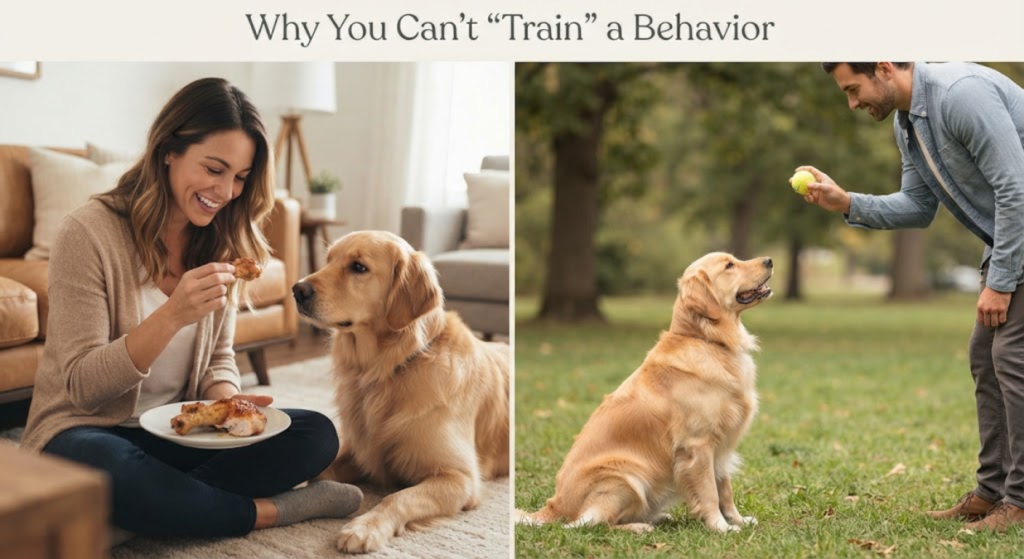
If you ask ten people what a “behavior” is, you’ll likely get ten different answers involving thoughts, choices, moods, or willpower. But if we strip away the fluff, a behavior is wonderfully simple: it is simply what an organism does to interact with its environment.
It’s an action. If a corpse can’t do it, it’s a behavior. (Breathing, walking, freezing, barking, pacing—those are behaviors. Being “stubborn” or “defiant” is just a label we invented to describe a pattern).
The Real Engine: Past Reinforcements
So, why do we do what we do? Why do dogs do what they do?
It isn’t because of a grand moral compass, spite, or free will. It comes down to one absolute rule: history.
Every single action we take today is a product of what happened yesterday, last year, and throughout our lives through a process called operant conditioning. Think of it as a permanent filing system in your nervous system: your very first reaction or consequence to something will be your forever reaction—good, bad, or indifferent.
When you encounter a situation for the first time, the outcome wires that neural pathway. If a specific action leads to a positive reward or successfully helps you escape stress, your brain logs that as a win, and you are primed to repeat it. If it results in pain, fear, or confusion, that snapshot is locked in just as tightly, steering you away from it in the future. Behavior is shaped entirely by these environmental consequences. We aren’t randomly deciding to behave; our reinforcement history is making the choice for us behind the scenes, using that initial imprint as its permanent guide.
Why You Can’t “Train” a Dog
This brings us to a hard truth about our canine companions: You cannot actually “train” a dog.
Traditional dog culture loves to talk about “training” as if it’s an obedience factory where you install a set of permanent commands into an animal’s brain, like downloading software. People think if you just use the right tools, the right corrections, or the right amount of “leadership,” you can program a dog to be a robot.
It doesn’t work that way because behavior is fluid, not a static trick.
You can’t “train” a behavior into existence and expect it to stick regardless of the environment. If the current environment doesn’t support the behavior—or if the reinforcement history changes—the behavior changes instantly. When we try to “train” a dog using coercion, force, or traditional quadrant models, we’re fighting against biology. We’re treating symptoms while completely ignoring the actual environmental triggers and reinforcement histories driving the dog in the first place.
Changing the Lens
Instead of trying to “train” a dog, our job is to become scientists of the environment.
When we stop looking for internal motives and start looking at the actual contingencies—what the dog is getting out of the moment, how their history has shaped their stress or drive, and what the environment is asking of them—everything changes.
Stop trying to force obedience, and start managing the environment. When you change the environment, the behavior takes care of itself.