
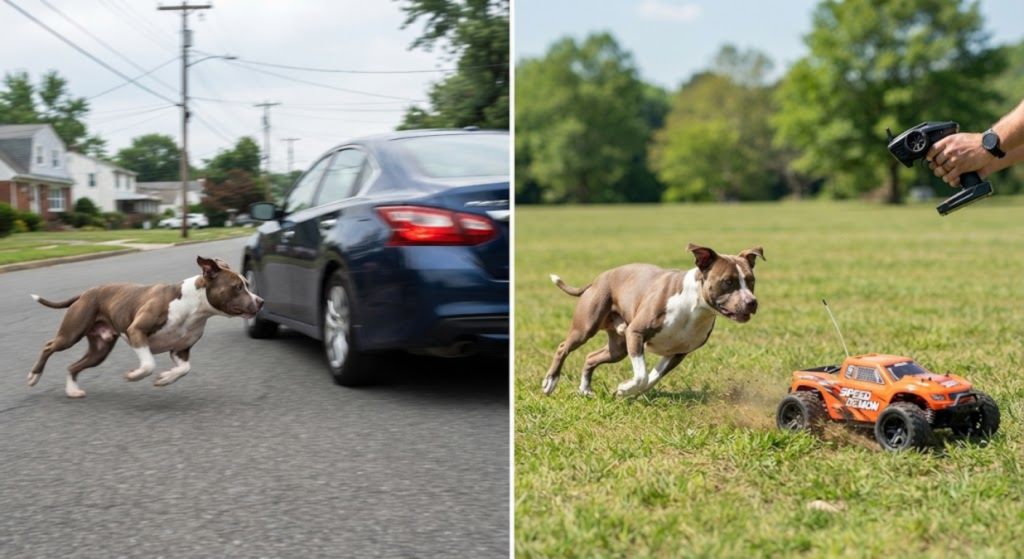
Before we look at the chaos of car chasing, let’s step back and see the world entirely through the dog’s eyes. When we talk about adding and removing things, it’s the dog that is doing the adding and removing, not us. We have to look at consequences strictly from their point of view—where “positive” and “negative” don’t mean good and bad, and where human intentions don’t matter at all.
To the dog experiencing the environment:
- Positive Reinforcement is what the dog adds to the situation—such as food, water, shelter, the basics of survival, or internal states like a rush of adrenaline and the feeling of winning.
- Negative Reinforcement is what the dog removes from the situation, like making a scary, loud moving object disappear.
The object itself acts as the negative reinforcement, and negative reinforcements generate behaviors of fight and flight.
Because the dog is the one driving the action, what they experience as a positive consequence isn’t always what we would choose.
1. The Ultimate Game of Tag
To a dog looking at the world, a fast-moving car triggers hardwired instincts. It looks, sounds, and smells like fleeing prey. When it moves fast, the predatory sequence kicks in through their own eyes: they see it, and they add movement to the chase.
2. Copycat Culture
Dogs learn from each other just like we do. If a puppy or a new dog watches another pack member explode into a chase, they join right in. Before you know it, chasing cars becomes a shared group sport driven by the dogs themselves.
3. The Power of “Winning”
This is where the dog’s perspective creates a trap.
- Every time the dog chases a car, the car drives away.
- From the dog’s point of view, they successfully removed the threat and scared the giant metal beast off.
- That perceived “win” adds a massive internal reward, reinforcing the behavior instantly through their own actions.
Even worse? A few rare dogs actually manage to catch a car. Surviving that crazy adrenaline rush makes the compulsion ten times stronger for next time.
Why It’s So Addictive
Why is this habit so impossible to break? Because of those exact consequences the dog keeps creating and repeating. When the behavior gets reinforced over and over again by the dog’s perceived “success” of the car fleeing, that repeated reinforcement becomes an addiction. It’s hard to stop a loop when the payoff hits just right to keep them hooked.
Fixing the Root Cause: Giving the Chase a Proper Outlet
Car chasing isn’t an obedience problem to be “trained” away with quick fixes or punishment; it’s a symptom. It’s the outward outcome of an underlying cause that isn’t being addressed.
Applied behavior analysis is about understanding the actual cause of a behavior rather than just fighting the symptom.
Look Through the Dog’s Eyes: What’s Missing?
Most dogs exist genetically to chase, but many of them never actually get to do it safely. Their built-in purpose for existing is being ignored. When those deep-seated genetic drives aren’t addressed, the dog finds an outlet on their own—like a passing car.
If we want to stop the car chasing, we have to stop treating it like a bad habit and start treating it as an unmet need. We have to address the genetics.
The Solution: Redirect, Don’t Suppress
You don’t break the cycle by punishing the dog for trying to survive or flee from a scary object. You break it by introducing an alternate behavior: “Chase this instead—and I’ll be consistent with it.”
It’s all about the chase, not the kill. By giving the dog a designated time and place to safely fulfill those biological drives, we remove the need for them to target vehicles.
- Flirt Poles: A classic, highly effective tool that has literally saved the lives of high-drive dogs like pit bulls by letting them safely engage the predatory sequence.
- Remote-Controlled Cars & Drones: Perfect substitutes that mimic the high-speed movement of fleeing prey, letting the dog hunt down a moving target in a controlled environment.
- Alternative Outlets: Slat mills, carpet mills, or structured puzzle-solving can also satisfy that pent-up energy.
When you satisfy the underlying drive, the symptom disappears.