
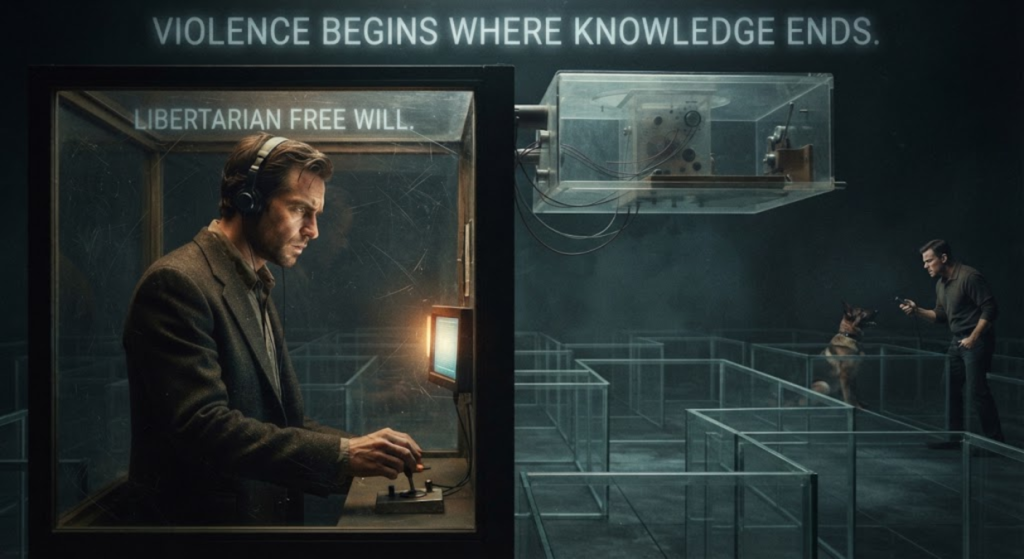
We love to flatter ourselves. As a culture, we cling tightly to the myth of libertarian free will—the comforting fairy tale that every choice we make is an uncaused, magical act of pure individual autonomy.
But when you strip away the illusion, what you are left with is a trap. Libertarianism tells you that you are entirely free inside your little glass cage, meaning any misery, failure, or confusion you experience is purely your own fault. You chose to be there.
That is the ultimate Thorndike box—a closed, artificial environment where organisms are forced to scramble for pellets of validation, all while being told their frantic struggling is proof of their glorious independence.
For decades, critics blamed B.F. Skinner and radical behaviorism for putting humanity in that box. But they had it completely backward. Determinism is what exposes the box in the first place. Determinism turns on the floodlights, maps the levers, and asks who built the cage and what reinforcement schedules are keeping us trapped. You cannot dismantle the constraints of an environment if you are too busy patting yourself on the back for “choosing” to run the maze.
The Myth of the “Expert” and the Scam of Symptom-Chasing
This illusion of autonomous control bleeds into every corner of modern life, creating a war between two entirely different ways of understanding living organisms.
On one side, you have the “symptom experts”—the traditional medical, psychiatric, and conventional training models. Rooted in the myth of free will, they treat behavior as the cause. They slap labels on symptoms, hand out pills, or demand compliance, entirely ignoring the environmental contingencies driving the individual.
On the other side, you have the radical behaviorist. But true radical behaviorism doesn’t claim to be an expert authority holding priestly wisdom. As Skinner noted in the opening lines of About Behaviorism, behaviorism is not the science of human behavior; it is the philosophy of the science.
A true determinist cannot claim to be an expert in the traditional sense, because an expert implies someone possessing internal, mystical wizardry. Instead, a behaviorist views themselves simply as a student of contingencies. They look at the machine, trace the gears, and recognize that they, too, are biological organisms shaped by the exact same laws of physics and history as everyone else.
In fact, mainstream “behaviorism” has largely become a scam because people focus exclusively on behaviors rather than causes. They treat living beings like vending machines—insert token, get output—using crude environmental micromanagement instead of mapping the actual ecological history.
From Humans to Animals: The Universal Law
The bedrock truth of radical behaviorism is simple: When it comes to behavior, replace “human” with dog, cat, pigeon, or rat.
The moment we strip away our anthropocentric ego, we realize that the laws of behavior apply across the board. A pigeon pecking a disc, a rat pressing a lever, a dog reacting to a trigger, and a human screaming on the internet are all operating under the exact same foundational principles of reinforcement, extinction, and environmental contingencies.
Yet, nowhere is the lethal failure of the free-will myth more apparent than in modern dog training.
The Libertarian Dog Trainer and the Logic of Violence
A libertarian dog trainer will look at an animal in distress, reactivity, or confusion, and tell you with a straight face that the dog has free will—that it is making a conscious, malicious choice to disobey, defy, or dominate.
Why do they cling to this absurd narrative? For no other reason than to employ punishment.
If you believe a living organism has uncaused free will, then bad behavior is an intentional moral failure. And if it’s a moral failure, you don’t need to look at the environment, the stress, the past trauma, or the faulty reinforcement schedules; you have a “clear conscience” to inflict force, use coercive tools, and dominate the animal.
As the old saying goes: Violence begins where knowledge ends.
When the very first thing an authority figure, a teacher, or a dog trainer reaches for is violence, punishment, or dominance, they aren’t demonstrating strength or mastery. They are demonstrating profound ignorance.
If you rely on coercion because you are too intellectually lazy to map environmental causes, take a good, long look in the mirror at the animal staring back at you. You are nothing more than a slave to cause and effect, acting out your own conditioned ignorance while lying to yourself about your freedom.
Step Out of the Box
True understanding doesn’t come from pretending we possess magical free will, nor does it come from brute-forcing obedience with a heavy hand.
It comes from dropping the ego, dropping the demand for artificial control, and studying the actual contingencies shaping behavior—whether in ourselves, our society, or our dogs. Stop blaming the organism, stop worshiping the illusion of uncaused choice, and start looking at the environment.