
Before we dive into the deep end, let’s clear up two big words we’re going to use:
- Libertarian (Free Will): The belief that every single choice we make is totally up to us, happening completely out of nowhere, and that we are fully independent authors of our actions.
- Determinist (Cause and Effect): The belief that everything we do has a cause—shaped by our genetics, our past history, and our current environment, just like everything else in the natural world.
Now, let’s talk about morality, fake virtue, and why pretending we have total “free will” keeps us from actually growing up.
The Illusion of “Moral Superiority”
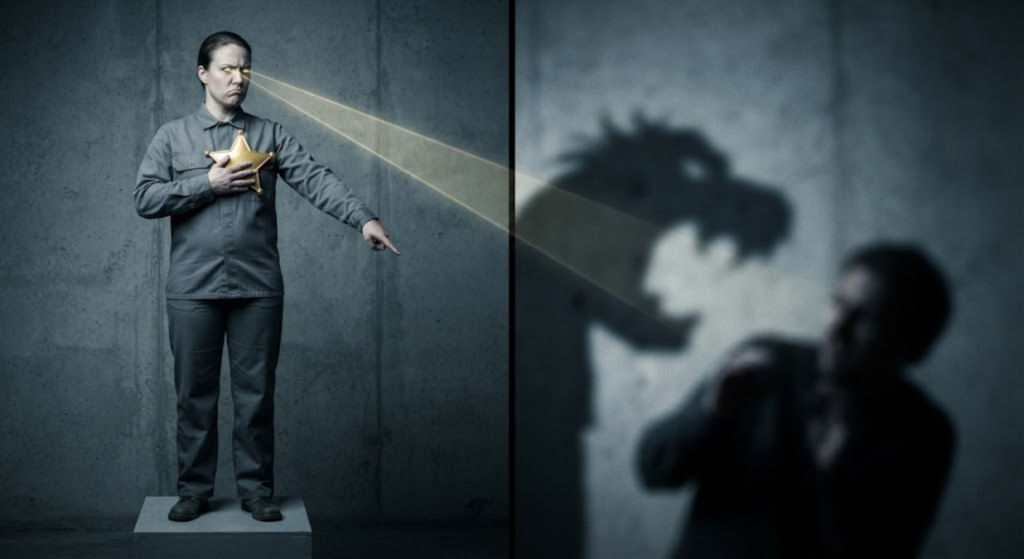
Society loves to hand out gold stars for being “good.” Usually, what people call “morality” is just a set of rules handed down by culture to keep everyone in line.
When people act morally superior, they are usually treating their rule-following like a shiny badge. They use it to judge, look down on, and control everyone else. They want you to believe they are pure, good, and completely incapable of doing anything wrong.
History shows how dangerous that fake virtue can be when ordinary people get the backing of institutional power. In 1930s Germany, a population conditioned on rigid obedience and righteous conformity easily transformed into perpetrators of atrocities. Armed with a manufactured sense of moral and racial superiority, ordinary citizens didn’t just comply with the regime—they eagerly turned on their neighbors, convinced they were purging impurity to protect society.
That same psychological mechanism exploded into plain view during the COVID pandemic. Millions of people eagerly slipped into the role of self-appointed enforcers, thrilled to rat out neighbors for walking outside or gathering with family. Protected by a veneer of institutional righteousness, the morally superior didn’t just ask for compliance—they demanded the unvaccinated be segregated, stripped of their livelihoods, forced to wear digital passes or badges, and treated as biological contaminants. Driven by righteous panic and state-backed moral superiority, the rhetoric from the compliant mainstream frequently crossed into open dehumanization, with extremists openly calling for the unvaccinated to be fired from society, locked away, or worse.
Enter the Shadow
Psychologist Carl Jung blew a hole right through that kind of fake righteousness. Jung argued that you cannot be truly moral unless you recognize your capacity for doing terrible things.
If you walk around believing you are 100% good, you aren’t moral—you’re just asleep at the wheel. You are pushing your dark, messy impulses down into what Jung called the “Shadow,” and then projecting them onto other people.
True ethics require brutal self-awareness. You have to look at your dark side and own the fact that you are capable of messing up.
Why Free Will Keeps Us Blind
Here is where it gets interesting: You cannot integrate your shadow if you believe in libertarian free will.
If you think every action is just a magical, uncaused choice, then every bad thing you think or do has to be treated as a pure, intentional moral failure. It traps you in a cycle of guilt, denial, and pointing fingers. You can’t study why you did something; you just have to pretend the darkness isn’t there and double down on acting like a saint.
Determinism changes everything. When you look at behavior through a lens of cause and effect, your dark impulses aren’t mysterious sins—they are the natural product of your background, your environment, and your conditioning.
You stop judging yourself, you start looking at the actual causes, and you finally deal with your shadow instead of running from it.
The Breakdown of the Self-Righteous
So, what happens when someone clings to free will and refuses to face their shadow?
- Constant Finger-Pointing: Because they can’t admit their own dark side, they project it everywhere. They constantly see “evil” in everyone else while staying totally blind to themselves.
- Fragile Ego: Their entire identity is propped up on the illusion that they are purely good. The moment someone challenges that, they snap into defensiveness and righteous anger.
- Endless Guilt: Without understanding the real causes behind behavior, every mistake is treated as a moral disaster, keeping them trapped in a loop of self-blame.
All of this flows directly from the belief in free will. When people believe in uncaused choice, they believe that compliance or non-compliance is entirely a matter of individual moral failing. If someone acts differently than the crowd, the libertarian framework says they just “chose” to be bad, dangerous, or rebellious. That belief gives the mob a clear conscience to punish, segregate, and dehumanize others without ever looking at the environmental pressures, propaganda, or behavioral contingencies actually driving human actions.
Functional Sociopathy
When you strip away the polished veneer of “moral superiority,” what you are left with is essentially functional sociopathy packaged as virtue. While psychopaths are born with hardwired neurological differences, sociopaths are a product of their environment—sculpted by cultural conditioning and toxic contingencies.
A sociopath lacks empathy, exploits rules to manipulate others, uses righteous indignation as a weapon, and feels zero remorse when dehumanizing or punishing people because they view themselves as entirely above reproach. When an entire culture adopts the illusion of free will, it socializes that exact dynamic: people get to act out their darkest, most destructive impulses under the banner of righteousness, completely insulated by the belief that their targets “chose” to deserve it.
If we want to stop playing games and actually grow, we have to drop the fairy tale of uncaused choice. Stop running from your shadow, start asking why, and take a real look at what is driving the machine.