
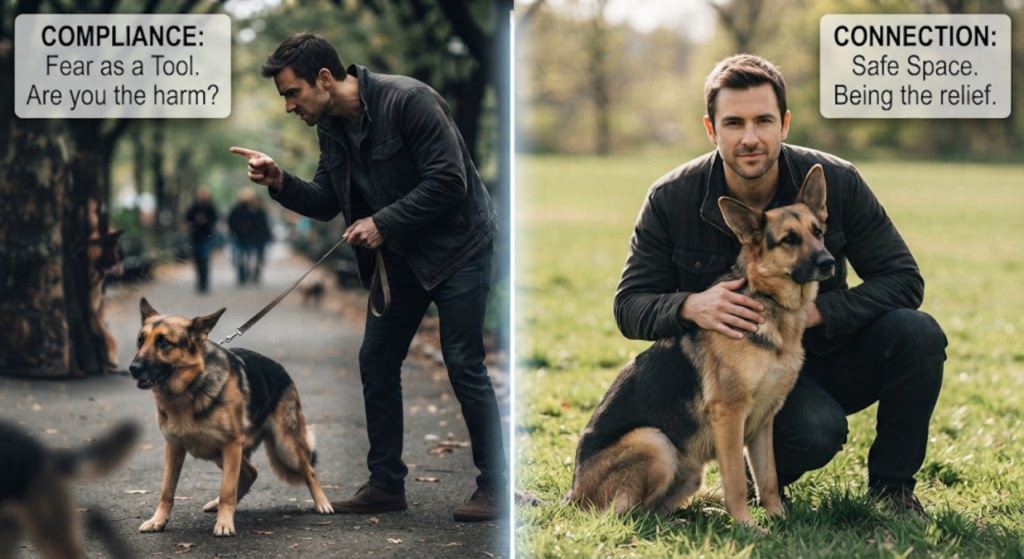
We throw the word “leader” around like it’s a gold medal. But let’s be honest about human history for a second.
Hitler was a leader. Dictators, tyrants, and despots throughout history have been “leaders.” They commanded absolute obedience. They controlled every movement, dictated every rule, and kept entire populations in line through surveillance, intimidation, and the constant threat of violence.
People complied. People marched. People fell in line.
But was it respect? Hell no. It was terror. Compliance extracted through fear is not respect—it is hostage-taking.
And yet, if you look at the modern dog training world, this is exactly the model of “leadership” people are told to use. We are handed choke chains, shock collars, and heavy hands, told that we need to dominate our dogs, prove we are the “alpha,” and keep them under our thumb. If the dog steps out of line, you lower the boom.
If you have to terrorize someone into staying by your side, you aren’t a leader. You’re a dictator.
The Other Extreme: The Vending Machine
On the flip side, you have the modern, sugar-coated extreme: the positive-reinforcement treadmill.
Instead of a whip, they hand you a pocket full of hot dogs and tell you to bribe your way through life. Every time the dog looks at you, ding! Dispense a treat.
But as neuroscientist Dr. Gregory Berns points out, positive reinforcement is often just a shortcut to train a trick. It is a transaction, not a relationship.
Think about it from a human perspective. If you have a “friend” who only shows up, smiles, and shares a snack when you do exactly what they want—but has zero emotional depth, offers no real security, and bails the second things get difficult—is that a best friend? Or is that just a human vending machine?
You aren’t part of the choice. You’re just holding the currency. The dog isn’t doing it for you; they’re calculating whether your kibble is worth more than whatever is happening across the yard.
The Human Test: What Is a Real Friend?
Let’s strip away the fur, the four legs, and the dog training books, and apply the ultimate human test.
What does a real friend look like?
- You trust them with your life.
- You know for a fact they would never put you in harm’s way.
- When the world gets scary, they actively protect you and keep you from harm.
If your dog were human, would they look at the way you handle them and call you a safe space? Or would they look at your reactions—the yelling, the quick frustration, the heavy-handed control—and look for the nearest exit?
If a human friend hooked a remote-controlled zapper to your neck, jerked you around by your throat when you moved too fast, and called it “leadership,” you’d call the cops. You wouldn’t trust them. You’d fear them.
Be the Relief, Not the Chaos
Here is the secret that the dog training industry misses entirely: You can give peace, or you can give chaos.
When a dog is terrified, overwhelmed, or completely unsure of what to do in a loud, confusing world, which person do you think they run to?
They don’t run to the dictator who screams and tightens the leash. They don’t look for the vending machine fumbling with a treat bag.
They run toward the calmest nervous system in the room.
Real leadership—whether you’re dealing with a two-pound Chihuahua or a 200-pound Mastiff—has nothing to do with domination, control, or bribes. It means being the absolute sanctuary in their environment.
It means understanding what positive reinforcement actually is at its core. True positive reinforcement isn’t handing out a piece of cheese; it is the deep, biological relief of escaping harm. It has real survival value.
When your dog is losing their mind, unsure of what to do, your job isn’t to block them, punish them, or inject more panic into the system. Negative reinforcement and aversive pressure don’t teach—they generate raw fight-or-flight behaviors. When a dog reacts, you have to ask yourself: What part of the environment is really causing this behavior? Are you the safe space they seek, or are you just another piece of the harm they need to escape from?
Your job is to be the rock. You absorb the pressure. You read the room, protect their space, and know when to simply step back and get out of the way.
When a dog truly knows you’ve got their back, the vigilance melts away. The reactivity fades.
They don’t need a metal collar to stay close to you. They stay by your side because being with you is the only place on earth where the noise finally stops, where the fear vanishes, and where they are truly safe.
Ask yourself honestly: Are you the safe space, or are you the harm they are trying to escape from?