
If you want to understand why the modern dog training industry is a multi-million-dollar house of cards, you have to look past the treat pouches, the prong collars, and the sterile obedience classes. You have to look at the human ego.
Because at the end of the day, a dog doesn’t need a trainer. The human needs a mirror.
The Brutal Honesty of a Dog
If there is one thing that separates dogs from the people who “own” them, it is this: Dogs cannot lie.
They don’t have a public persona. They don’t have a hidden agenda, a polite corporate smile to mask their contempt, or the capacity for hypocrisy. When a human acts out of insecurity or fear, they can wrap it in intellectualizations, social graces, or a subtle deflection.
A dog doesn’t have that luxury. They are entirely, brutally raw. They cannot hide their emotions, and they most certainly cannot hide their intent. What you see—the posture, the breath, the micro-expressions, the neurological state—is precisely what is happening in real time.
And that radical transparency terrifies us.
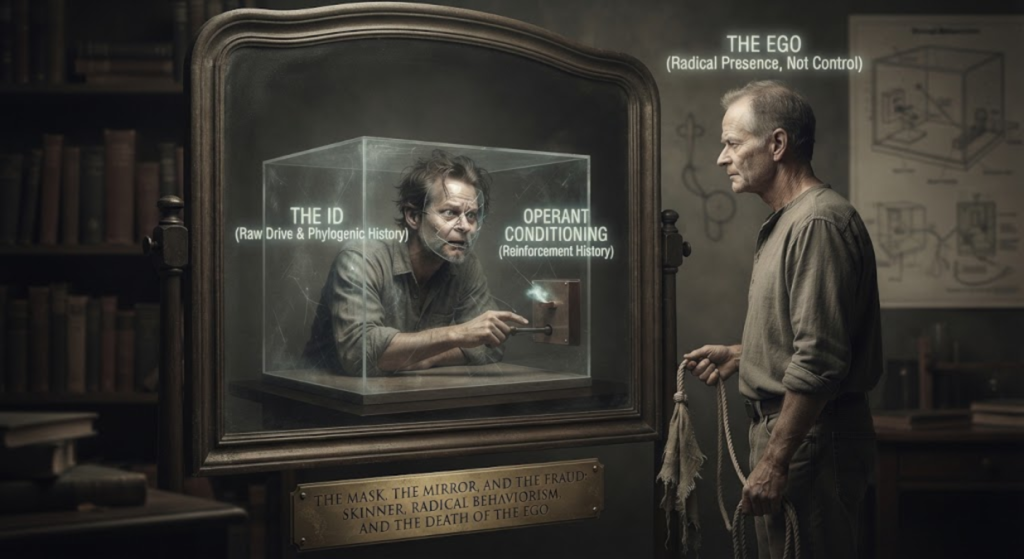
The Human Trap: The Mask, the Id, and the Superego
The root of almost every failure in dog ownership comes down to a single, pervasive problem: The ego is always the problem, and the mask is what protects it.
We spend our entire lives constructing a social persona. We care deeply about what the neighbors think, how our status looks, and whether our environment reflects well on our “brand.” But this constant performance doesn’t come free. It creates an internal war zone governed by the friction between our primitive drives and our societal constraints:
- The Id: The raw, unvarnished, biological drives—fear, anger, survival instincts, and the deep need for purpose.
- The Superego: The internalized moral policing of society, telling us how we ought to behave, what makes us “good” citizens, and how to suppress our natural state to fit in.
Because most people lack even a basic understanding of depth psychology—of how the Id and Superego constantly battle beneath the surface—they are forced to mask up. We wear a mask of control, a mask of perfection, and a mask of authority.
And when that mask cracks? When an animal or life itself refuses to play along with the performance? Panic sets in.
The Puppy’s Operating System: What Are You Imprinting?
Nowhere is the damage of the human ego more profound—or more tragic—than at the very beginning of a dog’s life.
People get a puppy, and they focus entirely on the logistics: crate training, house-breaking, socialization checklists, and obedience drills. But science and biology tell us a far more critical story. For those first crucial weeks—that critical window of vulnerability—that puppy’s brain is wide open. It is imprinting. It is building the core neurological operating system that will carry it for the rest of its life.
And that raises a brutal, uncomfortable question that every new owner needs to ask themselves:
What is the puppy actually imprinting on?
Is it imprinting on stability, environmental clarity, and natural guidance? Or is it imprinting on your ego? Is it downloading your mask?
When an owner approaches a puppy through a lens of anxiety, control, and status-seeking, the puppy doesn’t learn how to navigate the world. Instead, its developing operating system hard-codes the handler’s internal panic. Every over-correction, every frantic emotional reaction, every time you force the puppy to suppress its natural biological drives just to suit your suburban convenience—that gets written directly into the dog’s foundation.
You aren’t shaping a balanced animal; you are installing your own neuroses into a living creature.
By the time that puppy grows up and starts expressing stress, reactivity, or “defiance,” the commercial dog training industry steps in to sell you tools to fix the dog. But the operating system was corrupted on day one by the person holding the leash.
The Illusion of the Canine “Ego”
For the average suburban owner, a dog is often treated as an extension of that very ego—an accessory that has to reflect well on them. Every single misbehavior feels like a personal indictment of character, triggering defensiveness, anger, and a desperate need to dominate.
People often ask if an ego can be developed or created in a dog. Strictly speaking, no. Dogs don’t have an ego. They aren’t sitting in the corner worrying about their reputation or their social standing.
Yet, humans project, manufacture, and structurally reinforce an ego-driven proxy in an animal. Because dogs are hyper-attuned to human nervous systems, they mirror our internal chaos. If an owner is trapped behind a mask of anxiety, status-seeking, and transactional control, the dog anchors its behavior to that tension. To an outside observer, the dog might look “tough” or “defiant.” But under the hood, it’s not an ego—it’s a chronic state of adrenaline management, performing a role just to survive the human’s expectations.
Why the Working Dog Shames the Suburban Pet
If you want to see what a real relationship with a dog looks like, forget the suburban obedience class. Look at working dogs out on the land doing what they were bred to do—or look at the dogs belonging to unhoused people.
Walk through any city, and you’ll notice it. People passing by will feel a quiet, heavy sense of envy: How is that dog sitting off-leash, completely tuned in, perfectly calm amidst city chaos, while my dog loses its mind behind a fence?
How is it that someone living on the street can have a wonderful, rock-solid dog without spending a dime on trainers, aversive gear, custom diets, or clicker timing?
The answer is simple: Their ego has been stripped away.
An unhoused person doesn’t have the luxury of ego or superficial status games. They aren’t worried about what the neighbors think, and they aren’t projecting human anxieties onto the animal. Without the distraction of screens, schedules, and societal noise, they exist in a state of radical presence. Dogs calibrate instantly to a human who is calm, grounded, and entirely present.
Compare that to the modern suburban life. We don’t need the dog anymore in reality. Our lives are too convenient now, and by comparison, the dog isn’t convenient anymore. But instead of adapting, we flipped the script: Instead of the dog fulfilling its purpose, the dog is expected to fulfill our needs.
That is not a partnership. That is a hostage situation.
The Training Industry Scam: Punishing the Stress Response
When the inevitable friction of a captive, unfulfilled animal hits a suburban household, the commercial dog training industry steps in to cash the check.
They sell you a remote control with a “mute” button. They sell you a shock collar, a prong collar, or a pocketful of bribes, telling you that your dog is “defiant” or “aggressive.”
Let’s call it what it actually is: Negatively reinforced behavior emitted in the presence of events that evoke or illicit the biology of stress or fear—events that pose minimal risk of harm.
Translating that out of the clinical jargon: Punishing a dog for freaking out over something harmless doesn’t fix the problem—it just teaches them to panic harder.
When a dog has a meltdown over something that isn’t actually dangerous, adding a shock, a choke, or a correction doesn’t teach them anything. It just takes their natural fear and turns it into a stressful guessing game where they learn that the world—and their handler—is genuinely unsafe.
Go Spend Your Money
This is why trying to convince a novice owner of real psychology is often an exercise in futility. Some people are simply not ready for psychology. They want a quick fix, an obedience certificate, and a gadget to silence the beast.
To anyone caught in that treadmill, the message is simple: Go spend your money. Hire your trainers. Get it out of your system.
Buy the aversive tools, sit through the clicker seminars, and let the “balanced” trainers blame you for your dog’s genetics. Exhaust every single shortcut until your ego is completely broken down, your wallet is empty, and you are entirely out of options.
And when you finally realize that the training industry is a scam—when you realize that obedience is a bandage on a biological wound—come back.
The door is always open.
Because once you strip away the human need for status, throw out the treat bag, tear off the societal mask, and learn how to meet your dog’s raw, biological drive with radical honesty… you won’t need a trainer ever again.
You’ll just be two partners, living in the truth.