
There is a popular argument floating around the dog training world that goes something like this:
“My dogs get super excited when their e-collars come out. They aren’t thinking about electricity; they’re thinking, ‘Hell yeah, we’re going to do something fun!’ So it’s totally fine.”
Trainers love to use this excuse. They look at a dog happily shoving its head into a piece of hardware and call it “enthusiasm for the work.”
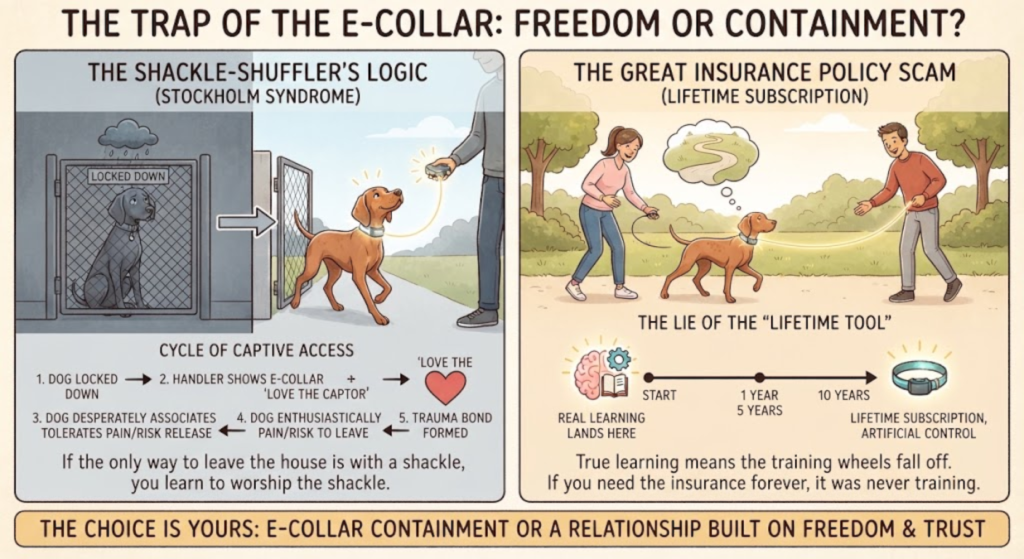
Let’s call it what it actually is: Stockholm Syndrome.
The Shackle-Shuffler’s Logic
Think about how conditioning actually works in a controlled environment. If a dog is locked down, restricted, or entirely denied access to the outside world unless that specific box is strapped to its neck, what choice does it have?
The tool becomes the exclusive ticket to freedom.
Imagine if the only way you were ever allowed to leave your house, feel the breeze, and do something fun was to strap a device to your neck that carried the constant threat of a sudden, invisible shock. You wouldn’t care about the device after a while—you’d start worshiping it. You’d shove your head right into the shackle because it means you finally get to escape the prison cell.
That isn’t a ringing endorsement of the tool. That is a captive animal desperately anticipating the only avenue of movement it’s allowed to have.
The Low Bar of “Not Hating It”
Defenders of aversive gear will argue that as long as the dog isn’t cowering or showing pure dread, the tool is ethical.
That is an embarrassingly low bar for animal care.
When an animal learns to tolerate the sword of Damocles hanging over its neck just to get a breath of fresh air, it isn’t giving enthusiastic consent. It’s calculating whether the pain is worth the payout. It’s trading its internal compass for a temporary taste of the outdoors.
The Great Insurance Policy Scam
Over the last fifteen-plus years, we’ve watched a massive shift in how these gadgets are marketed. Tools that used to be viewed as a last resort—extreme measures for extreme cases—have quietly morphed into an insurance policy.
Trainers realized that selling fear is much more lucrative than teaching education, so they repackaged these devices as everyday safety blankets: “Keep this strapped on forever, just in case.”
Here is the ultimate contradiction that exposes the whole scam: If an e-collar were actually a training tool, you wouldn’t need to use it for the life of the dog.
Think about how true learning works. When you teach a concept, the education lands in the brain, and the training wheels eventually fall off. You don’t need to keep holding up a flashcard forever once a lesson is mastered.
By calling these gadgets a “lifetime insurance policy,” the industry accidentally admits the dirty truth: the tools don’t actually train the animal. They don’t build emotional self-regulation; they just suppress biology on demand through the threat of discomfort. Because the animal never actually learns to self-manage, the moment you take the insurance policy off, the liability comes rushing right back.
Freedom Doesn’t Need a Battery Pack
Real trust doesn’t require a middleman strapped to a dog’s neck, and it certainly doesn’t require a lifetime subscription to artificial control.
When you ditch the gadgets and build a relationship based on clear, honest boundaries—the kind where an animal actually learns to self-manage—the gear vanishes entirely. You don’t need Stockholm Syndrome to get a dog to stick by your side when freedom isn’t gated behind a potential electric shock.
A dog sleeping soundly beside you isn’t waiting for a remote control to tell him he’s safe. He’s calm because he doesn’t have to love his captor; he just loves his life.