
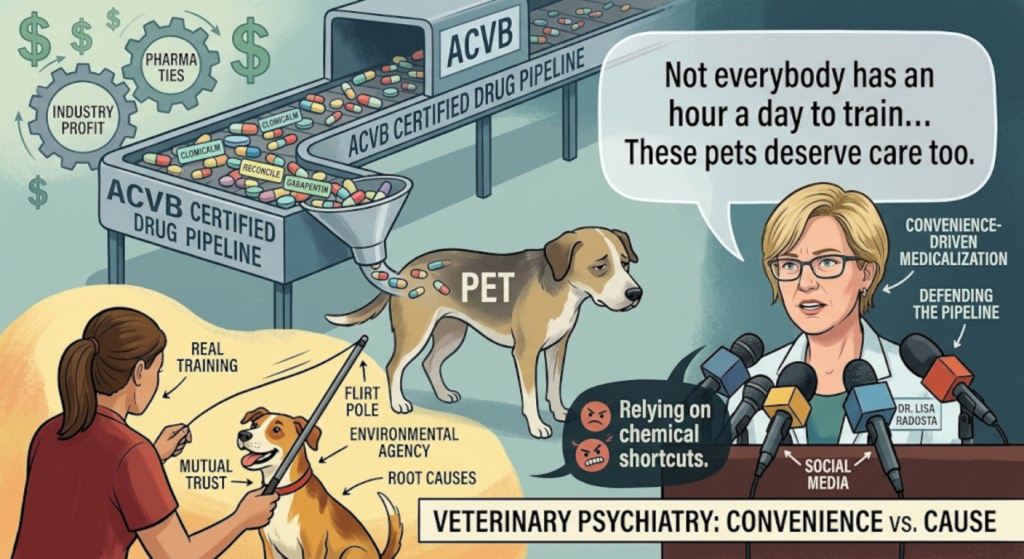
Dr. Lisa Radosta, president of the American College of Veterinary Behaviorists (ACVB), recently took to social media to scoff at critics who accuse her profession of relying on chemical shortcuts rather than real training. Dismissing concerned handlers as “trolls,” Radosta defended the ubiquitous use of psychotropic drugs in companion animals with a blend of professional defensiveness and lifestyle marketing: “Not everybody has an hour a day to train their dog or cat. Those pets deserve care too.”
When you strip away the clinical varnish, statements like this lay bare the actual operational model of modern veterinary psychiatry: convenience-driven medicalization and chemical symptom suppression.
The Historical Blueprint: Pharma Meets the Veterinary World
To understand why the veterinary behavior establishment is so deeply wedded to the prescription pad, we have to look at how the institution itself was built. The creation of the ACVB in 1993 was not a neutral evolution in animal care; it was heavily catalyzed by the commercial expansion of veterinary psychopharmacology.
As documented in historical evaluations of the veterinary specialty (such as Horwitz & Houpt’s 2020 review on the development of North American veterinary behavior, indexed on NIH/PMC as PMC7142705), the formalization of board certification coincided directly with the pharmaceutical industry’s push to bring human psychotropic drugs into the pet market.
Prior to this medical shift, animal behavior was primarily understood through ethology, environmental modification, and functional behavior analysis. Establishing an exclusive, AVMA-backed veterinary specialty created a proprietary medical gatekeeping tier. Suddenly, there was a licensed class of professionals legally authorized to diagnose “pathology” and prescribe heavy-duty psychotropic drugs—paving the way for FDA approvals of canine-marketed psychotropics like Clomicalm and Reconcile. The drugs became the primary concern, and the diagnostic framework was built to service them.
Conflating Organic Illness with Behavioral Adaptations
In her defense, Radosta leans heavily on a classic motte-and-bailey tactic: claiming that 50% of the animals brought to behaviorists are physically sick (pain, GI issues, skin disease) and that this illness affects their behavior.
No one argues that physical pain or underlying pathology alters an animal’s emotional baseline—any rigorous, cause-based assessment checks for medical variables first. But veterinary behaviorism uses this valid medical baseline as a Trojan horse. It leaps seamlessly from “treat physical pain” to “administer chronic neuro-altering psychotropics (SSRIs, TCAs, gabapentinoids) for environmental reactivity and stress.”
Behavioral expressions—whether reactivity, avoidance, or stress-coping mechanisms—are functional adaptations to environmental pressures, a lack of agency, or unfulfilled drive patterns. Pathologizing them into a brain chemistry defect justifies a lifetime subscription to pharmaceutical products.
The “Sandwich Generation” Alibi for Convenience
Radosta’s admission about the “sandwich generation”—that people are busy, stressed, and don’t have the time to invest in changing the environment or addressing root causes—reveals the true product being sold: dispensable compliance.
Real behavior modification requires structural changes, environmental management, patience, and honoring an animal’s native motor patterns through non-coercive physical outlets (like flirt poles, flirt lines, or appropriate tracking work). It asks handlers to build mutual trust and environmental agency.
Pharmaceutical intervention, by contrast, asks nothing of the environment and very little of the handler. It chemically mutes the animal’s outward expression, suppressing the symptom so the human lifestyle remains uninterrupted.
Defending the Pipeline
When the head of the ACVB mocks handlers who advocate for true behavioral foundations over chemical management, she isn’t defending animal welfare—she is defending an industrial pipeline. By framing chemical suppression as the ultimate expression of empathy (“No pet should suffer”), the institutional establishment ensures a steady, lucrative stream of patients dependent on pharmaceutical maintenance rather than true behavioral resolution.
Animals don’t suffer from a lack of SSRIs; they suffer when their environment, neurological design, and emotional agency are ignored.
What are your thoughts on the shift toward medicalizing normal behavioral stress in companion animals?