
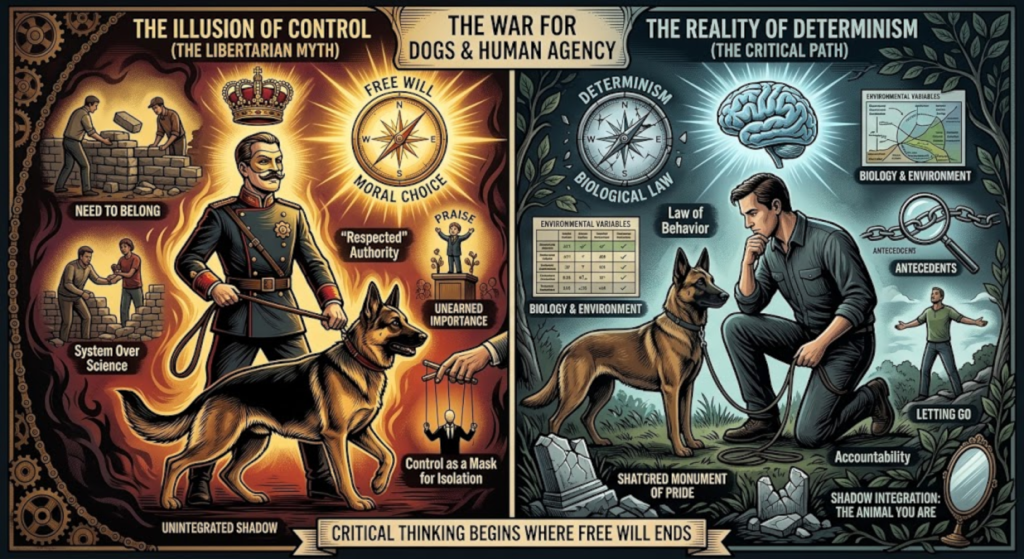
If you peel back the layers of the dog training debate—past the prongs, the e-collars, the treats, the rigid dog sports, and the endless internet arguments—you eventually run into a massive, fundamental wall.
It isn’t actually a debate about dogs. It is the age-old war between libertarian free will and determinism.
How you view the nature of existence determines how you handle a dog. For most people, letting go of the illusion of free will—and the absolute, personal control that comes with it—is the hardest thing they will ever do. Because accepting determinism doesn’t just change how you see your dog; it shatters your pride, strips away your ego, and forces you to confront the raw biological animal looking back at you in the mirror.
1. The Libertarian Myth: “He Knows What He Did”
The traditional, command-based training model—and the balanced, compulsion-based frameworks that rose out of early 20th-century militarism—relies entirely on a libertarian view of existence. It assumes that an organism operates with absolute free will, making conscious, moral “choices” to obey, disobey, respect, or challenge authority.
Under this framework:
- If a dog lunges at another dog, he is “choosing” to be bad.
- If he ignores a recall, he is “choosing” to test your leadership or test your boundaries.
- Because the behavior is framed as a moral choice, punishment feels justified.
The human gets to play the noble role of the benevolent judge dispensing justice. This perspective absolves the handler of all scientific responsibility. It ignores learning history, biological drive, baseline cortisol, neurochemistry, and environmental antecedents. It dumps the entire burden of morality onto a canine mind, turning behavior into a cheap drama about “respect,” “stubbornness,” and “discipline.”
2. The Determinist Reality: Behavior is Lawful
Radical Behaviorism strips away the ego, the grand drama, and the moralizing. It operates on determinism: behavior is not a choice made out of thin air by a tiny moral judge inside the brain. It is a natural, lawful, measurable function of genetics, past reinforcement history, and immediate environmental variables.
A dog doesn’t lunge because he’s disrespectful or testing your ego; he lunges because the environment triggered a response that has been reinforced by distance, relief, or arousal in the past.
When you accept determinism, the concept of punishment as “justice” or “teaching a moral lesson” completely collapses:
- You realize the dog isn’t making a moral choice—he is an organism reacting to variables.
- If the behavior is happening, the environment, biological state, and learning history created it.
- Blaming the dog for reacting to environmental antecedents makes as much sense as punishing water for boiling at 100 degrees Celsius.
3. Free Will vs. Critical Thinking: The Death of Inquiry
Believing in free will doesn’t make you open-minded—it actively stops you from critically thinking.
The moment you attribute an animal’s action to “free will,” “choice,” or “stubbornness,” your inquiry ends right then and there. You have given yourself a lazy, self-serving answer: The dog is just choosing to be difficult. No further analysis required. Case closed. Time for a correction.
Critical thinking demands determinism. Determinism refuses to let you off the hook. It forces you to put away your ego and ask the real, scientific questions:
- What were the environmental antecedents immediately preceding the behavior?
- What is the biological and neurochemical state of the animal right now?
- What reinforcer—positive or negative—is maintaining this behavioral output?
- How can I manipulate the environment, antecedents, and drive outlets to change the outcome objectively?
Accepting free will gives you a cop-out. Critical thinking forces you to sit down and do the science.
4. The Need to Belong: Ideology as a Mask for Isolation
Why do people fight so desperately to protect the illusion of free will, command-and-control hierarchies, and compulsion?
Because free will fuels the human ego. It creates the delusion that we are the grand, unconditioned architects of our identity, our moral superiority, and our dominance over others. But because that individual ego is fragile, unmoored, and often deeply isolated, it craves validation.
When people feel lost, lonely, or unempowered in their personal lives—struggling with broken dynamics, social isolation, or a world that feels completely chaotic—they don’t look for nuance. They seek out totalizing systems.
They look for binary, hyper-structured ideologies where everything is simple: black or white, dominant or submissive, right or wrong. Whether it’s online echo chambers, radical political posture, or rigid dog sports that demand absolute handler dominance through pain and pressure, the psychological mechanism is identical. It is a desperate search for certainty and control.
They trade one matrix illusion for another. They claim to reject societal narratives, only to plug themselves directly into early 20th-century Prussian military discipline and call it “canine science.” Controlling a powerful, high-drive animal through compulsion gives them a temporary high of authority—a mask to hide the deep vulnerability and lack of personal agency underneath.
5. Shadow Integration: Accepting the Animal You Are
This is why determinism is so fiercely rejected. Determinism doesn’t just change your training methods—it requires shadow integration. It demands that you accept the raw, unvarnished animal that you actually are.
To accept determinism, you have to do the terrifying psychological work:
- Destroying Human Exceptionalism: You have to stop pretending humans are divine, elevated beings operating on pure moral light, and accept that we—and the dogs living beside us—are biological organisms driven by evolutionary history, neurobiology, survival mechanisms, and environmental reinforcers.
- The Death of Pride: Pride requires the myth of self-creation. Pride says, “I built this through my sheer force of will,” or “I made this dog submit because I am the pack leader.” Determinism shatters that completely. It exposes that pride as nothing more than a defensive psychological construct.
- Stripping Away the Mask: When you realize that every flash of anger, every drive to dominate, and every need to punish is just an organism reacting defensively to feeling out of control, the mask slips off. You can’t play the hero, the judge, or the grand master anymore.
6. The Fear of Letting Go
High-control tools, physical compulsion, and rigid dominance hierarchies offer an immediate, intoxicating illusion of safety. They convince the handler that they hold absolute power over another living being’s choices.
To step away from that—to give an animal true agency, to trust environmental management, to fulfill raw biological drives through proxy outlets, and to manage antecedents without holding a threat of pain in your back pocket—requires letting go of the reins.
And letting go of control is the terrifying part. It means trusting that if you stop dominating, the system won’t fall apart. It means accepting that you aren’t a god commanding a subordinate; you are one biological entity arranging the environment for another.
Throwing the myth of free will in the garbage strips away every comfortable lie that protects a fragile ego. It leaves you with no moral high ground, no room for self-righteousness, and no excuses.
But once that pride shatters and the noise clears, you stop judging and start analyzing. You stop needing to dominate, and you start to actually understand.