
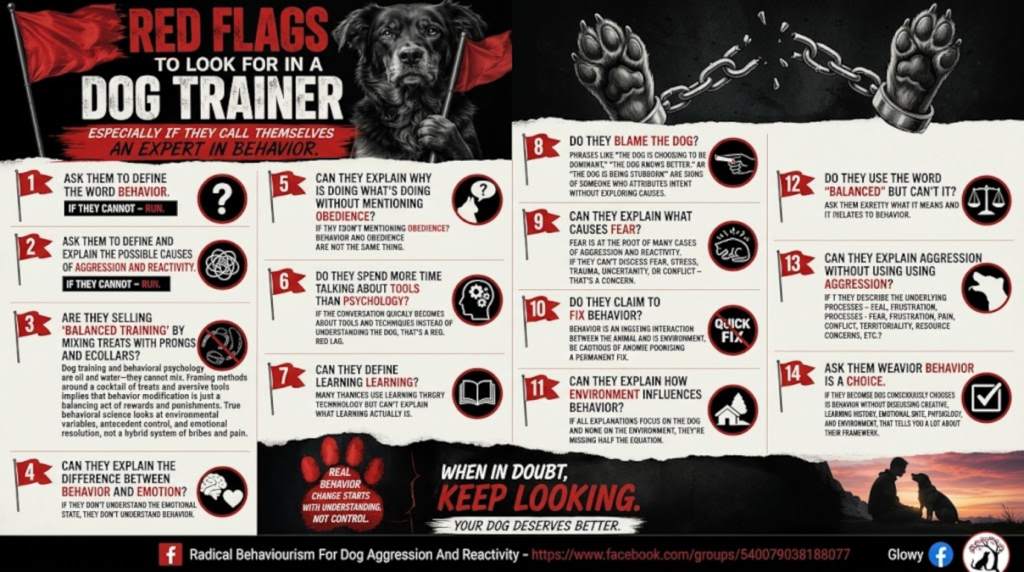
When you are desperately seeking help for a struggling dog, it is easy to hand over your trust—and your wallet—to anyone who claims to be an expert. But the dog training industry is largely unregulated. Anyone can hang out a shingle, call themselves a “behaviorist,” and start handing out advice that can make a dog’s world much worse.
If you want to protect your dog, you need to know what to look for. Here are the 14 red flags that expose a trainer who relies on control, coercion, and confusion rather than actual science.
1. Ask them to define the word behavior.
If they cannot define it—run. In actual science, behavior is the observable, measurable interaction between an organism and its environment. If a professional doesn’t know what behavior is, they have no business trying to change it.
2. Ask them to define and explain the possible causes of aggression and reactivity.
If they cannot, run. Aggression is never a random vacuum. It is an effect driven by underlying variables. If a trainer treats aggression like a moral failure rather than an environmental reaction, they are flying blind.
3. Are they selling “balanced training” by mixing treats with prongs and e-collars?
Dog training and behavioral psychology are oil and water—they cannot mix. Framing methods around a cocktail of treats and aversive tools implies that behavior modification is just a balancing act of rewards and punishments. True behavioral science looks at environmental variables, antecedent control, and emotional resolution, not a hybrid system of bribes and pain.
4. Can they explain the difference between behavior and emotion?
If they don’t understand the emotional state, they don’t understand behavior. Behavior is just the symptom; emotion is the engine. Suppressing the symptom while ignoring the terror or rage underneath fixes nothing.
5. Can they explain why a dog is doing what it’s doing without mentioning obedience?
Behavior and obedience are not the same thing. A dog can be completely obedient through fear and still be internally falling apart. Obedience is compliance; behavior modification is resolution.
6. Do they spend more time talking about tools than psychology?
If the conversation quickly becomes about prongs, e-collars, and techniques instead of understanding the dog, that’s a massive red flag. Tools are just a shortcut for handlers who don’t understand the science.
7. Can they define learning?
Many trainers use learning theory terminology as buzzwords, but they can’t actually explain what learning is. If they treat learning like a game of breaking a dog’s will, they are operating on outdated folklore.
8. Do they blame the dog?
Phrases like “the dog is choosing to be dominant,” “the dog knows better,” or “the dog is being stubborn” are telltale signs of someone who attributes human intent to a canine without exploring root causes.
9. Can they explain what causes fear?
Fear is at the root of many cases of aggression and reactivity. If a trainer can’t intelligently discuss fear, stress, trauma, uncertainty, or conflict—and instead just recommends a correction—that’s a serious concern.
10. Do they claim to “fix” behavior?
Behavior is an ongoing interaction between the animal and its environment. Be extremely cautious of anyone promising a quick, permanent “fix”. You don’t “fix” an organism; you manage and modify the environmental variables.
11. Can they explain how environment influences behavior?
If all of their explanations focus entirely on the dog and none on the environment, they are missing half the equation. The environment creates the behavior. Change the environment, and the behavior changes.
12. Do they use the word “balanced” but can’t define it?
Ask them what “balanced” means and how it relates to operational behavior. Usually, “balanced” is just a marketing term used to disguise the application of physical punishment under a veneer of fairness.
13. Can they explain aggression without using the word aggression?
Can they describe the underlying biological processes—fear, frustration, pain, conflict, territoriality, resource concerns, and internal arousal? True behavior professionals look at the specific mechanisms, not just a generic label.
14. Ask them whether behavior is a choice.
If they assume the dog consciously chooses its behavior without discussing genetics, learning history, emotional state, physiology, and environment, that tells you everything you need to know about their framework.
When in doubt, keep looking. Your dog deserves better. Real behavior change starts with understanding, not control.