
In the world of behavior analysis, few terms are as misunderstood as extinction.
In popular culture, “extinction” sounds dramatic—like a species wiping out or a total erasure of a behavior forever. In clinical settings, it’s often oversimplified or misused to mean simply ignoring someone or punishing them until they stop doing something.
To make sense of how behavior actually works, we need to clear the noise and look at what extinction really means, what it doesn’t, and how B.F. Skinner originally defined it.
What Extinction Is (The Skinnerian Definition)
B.F. Skinner, the pioneer of Radical Behaviorism, defined extinction as a very specific environmental process:
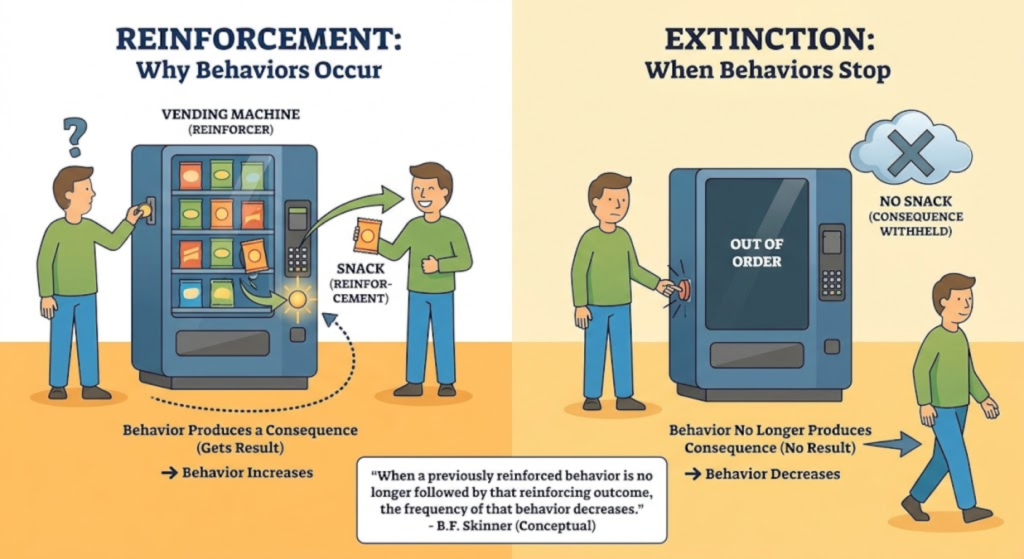
Extinction occurs when a previously reinforced behavior is no longer followed by that reinforcing outcome. As a result, the frequency of that behavior decreases over time.In plain terms: Behavior is driven by consequences. If an action produces a result that meets a need or gets a reaction, that action is likely to happen again. If you permanently disconnect the action from the consequence, the organism eventually stops wasting energy on an action that no longer yields a result.
A Simple Example:
Think of a vending machine.
You put in money, press the button, and get a snack (Reinforcement).

One day, you put in money, press the button, and nothing comes out (Extinction procedure begins).

You might press the button a few more times, press it harder, or shake the machine (The Extinction Burst).

When nothing continues to happen, you walk away and stop pressing the button (Extinction achieved).
What Extinction Is NOT
To understand extinction, it is just as important to know what it is not:
It is NOT Punishment

    Punishment adds an unpleasant consequence or removes a preferred item to suppress behavior immediately.

    Extinction adds nothing new and applies no coercion. It is simply the absence of the reinforcer that used to maintain the behavior.

It is NOT Simply "Ignoring" Someone

    Ignoring a person only functions as extinction if attention was the exact reinforcer keeping the behavior going in the first place. If a behavior is driven by escape, sensory input, or physical access to something, turning your back and ignoring it does not equal extinction.

It is NOT Erasing Memory or Unlearning

    Extinction does not wipe out a behavior from a brain like deleting a file from a hard drive. It simply changes the current environment so the behavior no longer works. (This is why behaviors can suddenly reappear later—a phenomenon known as spontaneous recovery).

It is NOT the Total Absence of Behavior

    Extinction applies to specific actions tied to specific consequences, not to a person or animal as a whole. An organism doesn't stop behaving altogether; it simply switches to other actions that do produce results in the current environment.
Why It Matters
When you strip away the jargon, extinction boils down to a fundamental law of nature: Organisms stop doing what no longer works.
When we understand extinction through Skinner’s lens—as a simple, neutral change in environmental consequences rather than a force or a tactic—we can look at human and animal behavior much more clearly, without getting caught up in unnecessary assumptions or emotional noise.