
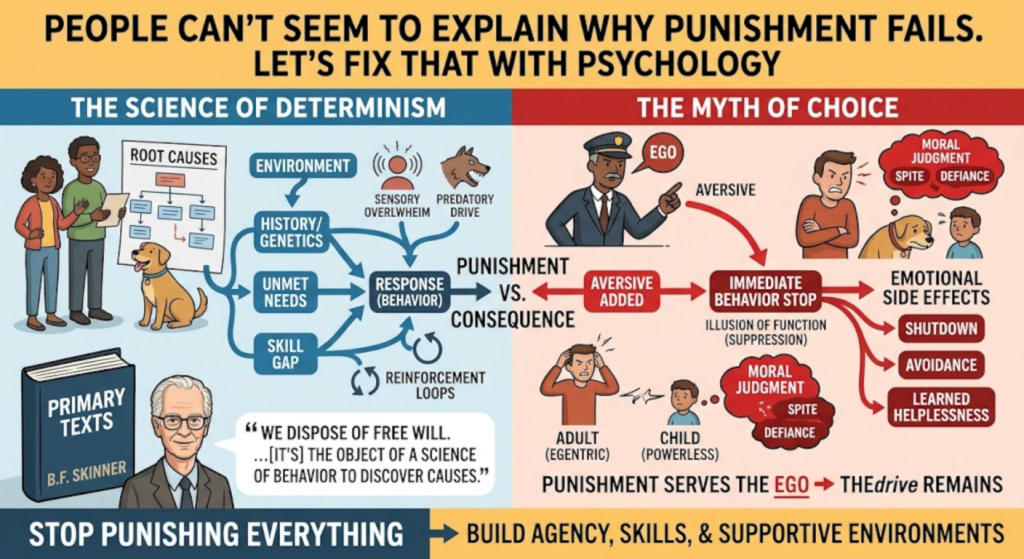
We love our illusions. In dog training, people cling fiercely to the idea of free will, treating a dog like a moral agent who chooses to be stubborn, disobedient, or spiteful. In the autism world, mouthpieces preach against punishment, but they can’t actually tell you why it fails—leaving them to swap out physical aversives for passive-aggressive social control.
Both sides are a mess. Why? Because almost nobody is willing to look at the actual mechanics of behavior. Instead, we rely on a comforting, lazy fiction: that every living thing around us is making conscious, malicious choices, and that we have the right to fix them through force.
If you want to understand why punishment is an absolute failure—and why it says everything about us and nothing about the dog or child in front of us—we have to strip away the noise, look at the science, and finally look in the mirror.
The Lie of the “Bad Choice”
Why do people punish? Because in the short term, it looks like it works.
An adult yells, pops a leash, or imposes a harsh consequence, and the unwanted behavior instantly stops. The adult gets immediate relief—their own negative reinforcement—and convinces themselves a lesson was taught.
Except nothing was taught. The behavior wasn’t resolved; it was suppressed.
As B.F. Skinner—the most misunderstood scapegoat in behavioral psychology—plainly stated:
“punishment is designed to remove behavior from a repertoire”
When you force-stop a behavior through a threat or an aversive consequence, you aren’t teaching a skill, providing an outlet, or addressing a need. You are attempting to erase an output. But you cannot simply erase a living organism’s response to its environment without breaking something underneath.
People confuse reinforcement with punishment because they don’t understand the direction of the stimuli. Negative reinforcement is the removal of an aversive thing to help an organism escape pain or danger and regain safety. Punishment is the exact opposite: the forced delivery of that aversive thing.
As Skinner noted, when someone spanks a child, yells, or threatens a dog because of “misbehavior,” they aren’t taking away stress—they are adding it. And when you inject an aversive threat into an environment, you don’t teach compliance. You trigger a survival drive. Negative reinforcement and aversives generate one thing: fight, flight, and escape. The individual’s nervous system is no longer processing your “lesson”—they are entirely occupied with surviving you.
Where Does the Behavior Go?
So if you punish a behavior, does it vanish?
No. It goes underground.
“A punished person remains “inclined” to behave in a punishable way, but he avoids punishment by doing something else instead, possibly nothing more than stubbornly doing nothing.”
Think about what that actually means. The underlying drive—whether it’s sensory overload in a child or a predatory/chase instinct in a dog—hasn’t gone anywhere. The frustration is still there. The unmet need is still there.
The individual just learns that expressing themselves brings pain, so they shift to avoidance. And when you push that far enough, you reach the end of the line: learned helplessness.
A dog sitting rigidly out of fear, or a child completely shutting down in the corner, hasn’t been “trained” or “rehabilitated.” They have simply learned that agency is a death sentence, so they stop trying altogether. Doing “nothing” isn’t progress; it’s a soul crushed into silence.
The Real Root: The Illusion of Free Will
Why do we cling to punishment so desperately, despite its complete failure as a teaching tool?
It all boils down to our cultural addiction to free will. We believe that every living thing possesses a magical internal engine—that they are choosing to act out out of malice, defiance, or bad character—and therefore, they deserve a consequence.
Skinner dismantled this entire fiction decades ago. As he explained in a simple, profound truth:
“we have assumed somehow or other that these internal States feelings and so on have initiated something they have started something they have created… if you now look at the actual history we find that there are external reasons why this has happened… by discovering the causes of behavior we can dispose of the imagined internal cause we dispose of Free Will.”
As the 18th-century divine Jonathan Edwards observed centuries ago, we believe in free will only because we are aware of our own behavior, but completely blind to its causes.
When you do not understand the environmental history, the sensory overload, the reinforcement loop, or the missing skills that actually drove a dog or a child to react, you default to the lazy fiction of a “conscious choice.” You assume they chose to defy you, which gives your ego permission to punish them.
Punishment Serves Only Your Ego
Once you embrace a science of behavior, you start looking for external causes—environment, history, triggers, and unmet needs. And once you find those causes, you realize there is nothing left to attribute to an internal act of will.
- The dog isn’t choosing to defy you.
- The child isn’t choosing to melt down.
- The living creature in front of you is simply responding to the environment you share.
When you strip away the illusion of choice, the truth is laid bare: Punishment has nothing to do with what the animal or child deserves. It has everything to do with the adult’s desire for control.
It’s time to stop punishing everything around us just because we refuse to examine our own discomfort. Punishment doesn’t fix the environment. It doesn’t build skills. It doesn’t foster trust. It only serves your ego—forcing a living, feeling organism into submission because you are too lazy, too impatient, or too arrogant to look at the real causes of behavior.