We love to complicate behavior. We invent moral failings, character flaws, and internal diagnoses to explain why living organisms—whether a dog or a human—do what they do.
If you strip away the noise and look at the raw mechanics of B.F. Skinner’s work—famously articulated by his fictional mouthpiece, Frazier, in Walden Two—behavior boils down to three basic states.
The Three Classes of Experience
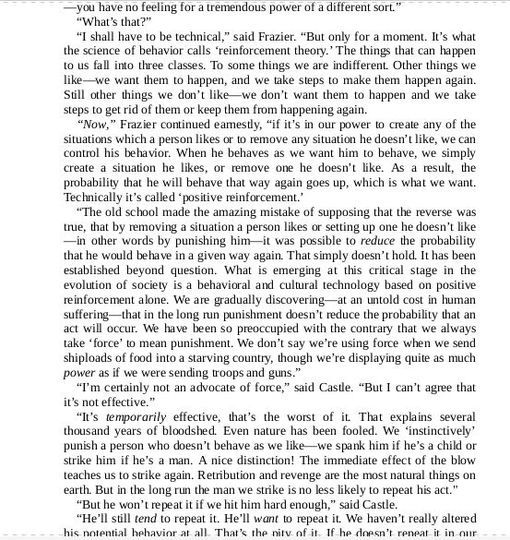
As laid out in the text, everything that happens to an organism falls into one of three classes:
- Indifference: Things we don’t care about either way. They don’t move the needle. JPG
- Appetitive (Wanting): Things we like and actively work to make happen or repeat. This is positive reinforcement in action—creating a situation a person or animal likes to increase the probability that they’ll do it again. JPG+ 1
- Aversive (Fleeing/Fighting): Things we dislike and actively work to get rid of, escape, or keep from happening. JPG
When faced with a stimulus, an organism fundamentally does one of three things: it fights, it flees, or it is indifferent. It is vectoring forward to engage, vectoring away to escape, or staying neutral.
The Great Illusion of Punishment
This brings us to the core trap of human history: punishment.
Traditional culture operates on the assumption that if you don’t like a behavior, you punish it. You take away what someone likes, or you inflict an aversive situation to stamp it out.
Frazier calls this out as an absolute illusion. In the long run, punishment doesn’t actually reduce the probability that an act will occur. It’s only temporarily effective—and that temporary illusion of control is what has fueled thousands of years of bloodshed, coercion, and human suffering.
We are “instinctively” drawn to retribution and revenge. Hit a child, and they cry; hit a man, and they strike back. The immediate effect of a blow teaches us to strike again. But even if you hit someone hard enough that they stop outwardly rebelling, you haven’t altered their potential behavior at all. You haven’t changed the underlying contingencies; you’ve just driven the response underground through fear and suppression.
Moving Beyond Force
As Frazier notes, we have been so brainwashed by the “old school” method of punishment that we forget power can be entirely positive. Sending shiploads of food into a starving country displays just as much power—and far more functional engineering—than sending troops and guns.
If we want actual behavioral change, we have to drop the lazy addiction to punishment and coercion. We have to understand the environment, control the contingencies, and stop confusing a temporarily suppressed, terrified organism with actual progress.