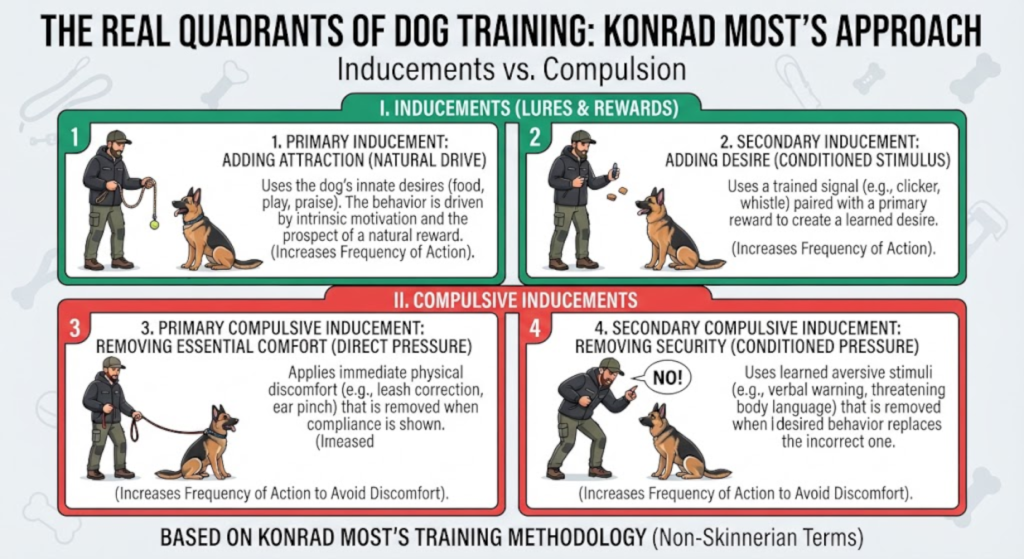
For decades, the dog training world has pointed the finger at B.F. Skinner. Trainers, behaviorists, and online gurus love to hide behind his laboratory work, claiming that the sacred “four quadrants” of dog training are a direct gift from behavioral psychology.
It is the biggest, most destructive lie ever told in the pet industry. And the resulting death toll—for both dogs and humans—is immeasurable.
B.F. Skinner never built a grid for training dogs. In fact, across his entire career writing 22 books and publishing 180 papers, he never once wrote the words “positive punishment” or “negative punishment.” If Skinner ever drew a box, it was only for reinforcement—positive and negative. There is no punishment in true radical behaviorism.
Skinner actually warned us about what punishment really is. In his book About Behaviorism, he wrote:
“Punishment is easily confused with negative reinforcement, sometimes called ‘aversive control.’ The same stimuli are used, and negative reinforcement might be defined as the punishment of not behaving, but punishment is designed to remove behavior from a repertoire, whereas negative reinforcement generates behavior.”
And as he further explained regarding the psychological fallout of trying to beat or suppress a behavior:
“A punished person remains ‘inclined’ to behave in a punishable way, but he avoids punishment by doing something else instead, possibly nothing more than stubbornly doing nothing.”
B.F. Skinner openly opposed the use of punishment. He knew that an animal cannot simply help how it acts. Behaviors are natural, biological responses to environmental contingencies—they are not conscious choices, moral failings, or acts of free will.
What That Means in Plain English: Learned Helplessness
When a trainer uses punishment—whether it’s a sharp pop on a prong collar or a forced time-out—they haven’t magically cured the dog’s mindset or solved why the dog feels that way. They’ve just terrified the dog into hiding it.
The dog still wants to react, sniff, chase, or bark. They’ve just learned that expressing themselves leads to pain or being shut down. So what do they do? Exactly what Skinner said: they figure out the safest survival strategy left, which is to shut down, check out, and stubbornly do nothing. It’s the textbook definition of learned helplessness.
Every single corner of dog training—whether they call themselves positive reinforcement, balanced, or force-free—is selling you the exact same endgame: Stop the behaviors! Shut down the behaviors! And they all use some form of inducement to do it, whether it’s a piece of boiled chicken dangled in front of a nose or a prong collar biting into a neck.
The real history of these so-called quadrants doesn’t come from a psychology lab. It comes straight from Chapter 2 of a 1910 German military manual called Training Dogs: A Manual by Konrad Most. And his title for them wasn’t some fancy clinical breakthrough. It was simply “Inducements and Compulsive Inducements.”
When you look at Skinner’s foundational work—such as the aversive control experiments mapped out in The Behavior of Organisms—the entire illusion of the “quadrants” shatters. At its core, what the industry calls “positive reinforcement” is actually just the removal of negative reinforcement—relief from a baseline state of demand or aversive pressure.
Let’s strip away the fancy academic disguise and look at what those quadrants actually mean:
1. Primary Inducement Became Positive Reinforcement
- The Military Root: In Konrad Most’s military playbook, primary inducement was about using basic biological leverage—handing out food to get an animal to move.
- The Real Deal: The modern dog industry took Most’s food-luring trick, wrapped it in fake psychology buzzwords, and called it Positive Reinforcement to make dangling a piece of chicken look like a clinical science.
2. Primary Compulsive Inducement Became Positive Punishment
- The Military Root: When food didn’t work, Most stepped up to primary compulsive inducement. That meant using raw physical force, pain, or a direct physical correction to beat a behavior out of the dog.
- The Real Deal: This is what the industry rebranded as Positive Punishment—the direct application of aversive control. Whether it’s a choke chain, a prong collar, a physical smack, or an electronic shock, the mechanism is straight out of Most’s 1910 military manual: use aversive pressure to shut the behavior down. Skinner never wrote a word about it, but the industry needed a scapegoat for their punishment machine.
3. Secondary Inducement Became Negative Reinforcement
- The Military Root: Most used ongoing, stressful pressure that only stopped when the dog finally did what it was told, forcing the animal to hustle just to escape the misery.
- The Real Deal: This is the application of negative reinforcement—aka punishment—used to shut down a behavior. It is keeping a dog trapped in a constant, low-grade state of aversive pressure (like steady leash tension or continuous e-collar stimulation) until they comply just to make the annoyance stop. But remember: negative reinforcements generate behaviors—specifically, the primal survival responses of fight and flight.
4. Secondary Compulsive Inducement Became “Negative Punishment”
- The Military Root: Konrad Most’s secondary compulsive inducements—applying aversive pressure at a distance to force compliance.
- The Real Deal: Negative punishment doesn’t exist. It is a completely made-up term invented to cover for Konrad Most’s secondary compulsive inducements—the e-collar deployed from across a field, or invisible electronic fencing designed to punish a dog the moment they cross an invisible line out of reach.
The Deadly Truth
There was never any modern psychology behind the quadrants. It is repackaged, Prussian police-dog coercion from over a century ago.
When trainers tell you they are using “science-based quadrants” to shape your dog, they are handing you a 115-year-old military control grid designed for war and police work. They use B.F. Skinner’s name to sound smart, all while hiding the fact that he never wrote a single word about punishment quadrants—and they are running Konrad Most’s exact playbook of manipulation, suppression, and control.
They bastardized Skinner – so they could steal the behaviorist label – but they are not qualified. I haven’t met a trainer yet that has actually opened a book from Skinner – and they have never heard the name Konrad Most – but read on.
And all of this has become what dog trainers call “Applied Behavior Analysis”—a method of behavioral modification using reward and punishment. Yay Skinner—the man that openly opposed punishment.
What they call Applied Behavior Analysis is the same lies and garbage sold to the Autism community, with the same devastating results. Almost 25% of Autistic adults have attempted to commit suicide, behaviorally euthanizing themselves due to the abusive and narcissistic system of control and management. That is millions of people.
As a result of these lies, millions of dogs are dead. Behaviorally euthanized by a bunch of people that can’t define the word behavior. And anyone pushing the quadrants—and blaming Skinner—has never read a book from Skinner.
Stop treating your dog like a military recruit, and stop buying into a system built entirely on coercion.